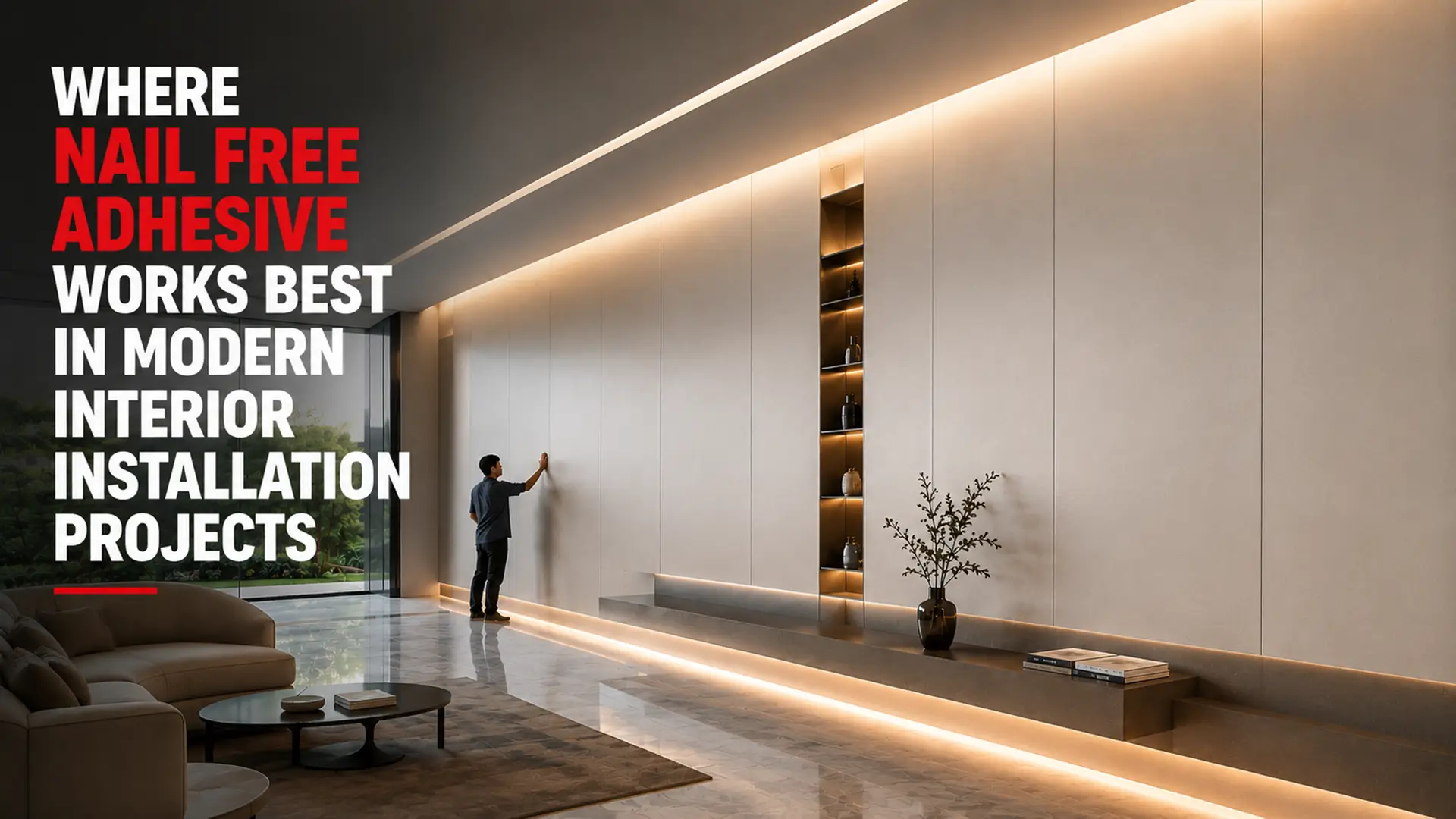
Where nail free adhesive works best in modern interior installation projects
Modern interiors increasingly favour clean detailing where decorative elements can be installed without making fixing points part of the visual composition. Trims, mouldings, panels, profiles and selected architectural features often need secure attachment while maintaining a refined appearance. Nail Free Adhesive can be useful in suitable applications where concealed fixing, efficient installation and neat detailing are important. Buildwell approaches adhesive based installation by looking at the actual requirements of each project rather than treating one fixing method as suitable for every interior component.
The growing interest in adhesive fixing also reflects a broader change in interior construction. Designers are paying closer attention to the smallest details because even a minor visible fastener can interrupt an otherwise carefully planned finish.
The right application comes before the fixing method
The first question should not be which adhesive to use.
It should be whether adhesive fixing is appropriate for the component, substrate and intended use. Lightweight decorative elements and selected Finishing Materials may have very different requirements from heavier architectural components.
Buildwell recommends assessing the size, weight, bonding area, position and material of the component before deciding on the fixing method.
When the application is appropriate, Nail Free Adhesive can provide a discreet way of attaching selected interior elements without introducing visible mechanical fixing points.
This application based approach keeps the focus on performance rather than convenience alone.
Decorative details benefit from concealed attachment
Interior design often depends on visual continuity.
Mouldings, trims, decorative profiles and selected panels can lose some of their impact when screw heads or nail marks remain visible across the finished surface. Concealed attachment allows the decorative element to remain visually dominant.
Buildwell considers this particularly relevant in areas where detailing is closely viewed, such as reception spaces, hospitality interiors, retail displays and premium residential settings.
Using Nail Free Adhesive for suitable decorative components can help maintain a cleaner appearance while reducing the need for visible mechanical fixing.
The result is a finish where the design element appears integrated rather than visibly attached.
Substrate condition influences the outcome
Adhesive performance depends heavily on the surface receiving the component.
Dust, loose particles, grease, moisture, unsuitable coatings or unstable finishes can affect the quality of the bond. Different substrates may also have different characteristics that need to be considered before installation.
Buildwell encourages contractors to inspect the intended surface and confirm compatibility before application.
For Nail Free Adhesive, this assessment is particularly important because the adhesive needs a suitable contact surface to develop the intended attachment.
A clean and appropriate substrate creates better conditions for controlled installation.
Where speed can improve the installation workflow
Interior finishing often involves repeated installation across multiple rooms or areas.
When a suitable component can be fixed without creating individual mechanical fastening points, the installation sequence may become simpler. This can be particularly useful when numerous decorative elements need to be positioned with consistent spacing and alignment.
Buildwell sees productivity as one part of a larger installation equation rather than the only objective.
In suitable applications, Nail Free Adhesive can reduce certain repetitive fastening activities and allow installers to concentrate more closely on positioning and detailing.
The real benefit comes when simpler installation also produces a cleaner finished result.
Mouldings and profiles are natural applications
Decorative mouldings and profiles often require accurate placement rather than heavy structural attachment.
Their purpose may be to define an edge, create a transition, introduce a visual frame or add detail around another interior element. Visible nails or screws can interfere with these functions.
Buildwell considers adhesive based fixing useful for suitable decorative applications where the component and substrate meet the product’s requirements.
Nail Free Adhesive can therefore be considered for selected mouldings, trims and profiles where concealed attachment supports both appearance and installation efficiency.
The specific application should always follow product recommendations.
Feature areas demand greater visual control
Some sections of an interior naturally attract more attention.
Reception backdrops, hospitality features, retail displays, office entrances and decorative sections are designed to create a particular impression. In these locations, fixing details can become noticeable because visitors are likely to view the finished surface closely.
Buildwell encourages project teams to consider the fixing method as part of the visual design rather than treating it as a purely technical decision.
Where appropriate, Nail Free Adhesive can help keep selected attachment points concealed and allow the architectural feature to remain visually uninterrupted.
This can be especially valuable when the design depends on clean lines and minimal detailing.
Not every installation should become nail free
A practical approach also means knowing when adhesive should not be used.
Heavy components, demanding loads, unsuitable substrates or applications outside the product’s intended use may require mechanical fastening or another attachment method. In some situations, adhesive and mechanical fixing may also serve different purposes within the same installation.
Buildwell recommends evaluating the component and application before making the decision.
The presence of Nail Free Adhesive in a product range does not mean every interior element should automatically be installed with it.
Good construction depends on choosing the right method for the actual requirement.
Positioning needs to happen before the bond is committed
Adhesive based installation requires more than simply applying material and pressing a component into place.
Measurements, reference lines, junctions and final positioning should be considered beforehand. Once the component is placed, the opportunity for adjustment may depend on the adhesive’s working characteristics.
Buildwell encourages installers to establish the intended position before application so the installation remains controlled.
Using Nail Free Adhesive effectively therefore requires the same attention to measurement and detailing expected from other professional finishing methods.
Concealed fixing still demands visible precision.
Material compatibility shapes the decision
Interior projects combine many different materials.
Decorative panels, trims, profiles, boards and mouldings may have different surface characteristics. The receiving substrate can also vary from one project area to another.
Buildwell recommends confirming that the adhesive is intended for the specific combination of materials before installation. Product guidance should remain the primary reference when determining suitability.
When the materials are compatible, Nail Free Adhesive can become a practical choice for selected interior applications where clean attachment is desired.
The goal is a dependable connection that also respects the design intent.
Think beyond installation day
A good interior fixing method should make sense after the project is handed over.
The completed element needs to remain appropriately positioned under its intended conditions while the surrounding interior continues to be cleaned, occupied and maintained. This is why application suitability matters more than simply achieving a quick installation.
Buildwell encourages professionals to consider the complete use environment before selecting an adhesive based fixing method.
For suitable applications, nail freecan support a cleaner installation approach while helping decorative elements remain visually integrated into the interior.
Conclusion
Modern interior construction increasingly values finishes where technical components remain visually discreet. Adhesive based fixing can support this direction when the component, substrate, environment and installation requirements are compatible.
Nail Free Adhesive is particularly relevant for selected trims, mouldings, profiles and decorative elements where concealed attachment can improve visual continuity and simplify repetitive installation activities. Its effectiveness depends on appropriate product selection, substrate preparation, accurate positioning and adherence to application guidance.
Buildwell continues to support architects, contractors and interior professionals with products suited to contemporary finishing requirements. Buildwell’s approach is centred on practical application rather than using the same fixing method everywhere.
For projects where clean detailing matters, Buildwell encourages professionals to evaluate adhesive fixing as one part of a broader installation strategy. When used in the right place and with the right materials, Nail Free Adhesive can help create interiors where the design remains the focus and the fixing method stays discreet.
Contact Buildwell
Email: sales@buildwell.in
WhatsApp: 7900336699
Toll free: 1800 102 8031