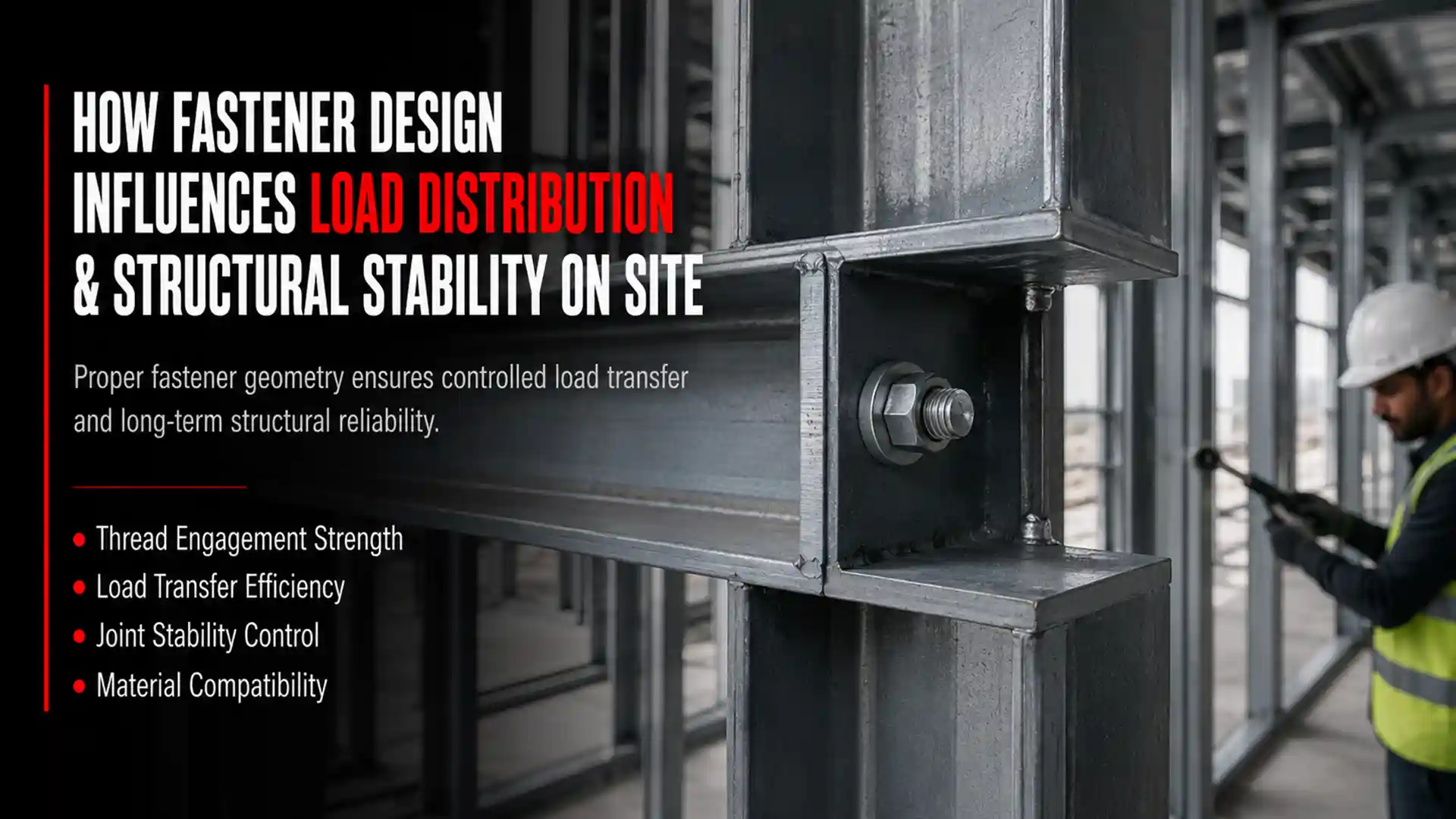
How fastener design influences load distribution and structural stability on site
In modern construction, structural performance depends on far more than major building components. While framing systems, boards, and finishing materials receive significant attention, fastening products play an equally important role in determining how assemblies perform over time. A structure may be designed with high-quality materials, but its long-term stability can still be affected if the fastening system fails to distribute loads effectively.
Buildwell recognizes that construction professionals increasingly evaluate fasteners not only for their ability to hold materials together, but also for how they contribute to structural integrity under practical site conditions. This growing focus has increased the importance of selecting the right Hex Head Screw for different applications.
Every connection point within a structure transfers forces. These forces include dead loads, operational loads, vibration, movement, and environmental stresses. The design of the fastener directly influences how these forces are distributed throughout the assembly. When load distribution remains balanced, structures perform more consistently and require less maintenance over time.
Understanding how fastener design affects structural behavior helps contractors, engineers, and project managers make informed decisions that improve both installation quality and long-term reliability.
Because strong structures rely on dependable connections at every stage of construction.
Fastener geometry plays a critical role in load transfer
The geometry of a fastener significantly influences how loads move through connected materials. Every structural assembly experiences forces that must be transferred safely across connection points.
A properly designed Hex Head Screw helps distribute these forces more evenly by creating stable contact between materials. When load transfer occurs uniformly, localized stress concentrations are reduced, helping preserve the integrity of both the fastener and the surrounding assembly.
Uneven force distribution can create weak points within the structure. Over time, these areas may experience movement, loosening, or surface damage that affects overall performance.
Buildwell understands that effective load transfer begins with thoughtful fastener design.
Because even small variations in connection behavior can influence long-term structural stability.
Head design affects installation and structural performance
Fastener heads do much more than provide a gripping surface for installation tools. Their design also affects how forces are distributed during tightening and throughout the operational life of the assembly.
A well-designed Hex Head Screw supports better torque application during installation, allowing contractors to achieve more consistent fastening pressure across multiple connection points.
Uniform tightening contributes to improved structural balance because each fastening point performs similarly under load. In large installations, this consistency becomes especially important for maintaining alignment and reducing future maintenance requirements.
Buildwell recognizes that installation precision and structural reliability are closely connected.
Because stable structures begin with controlled fastening practices.
Thread configuration influences holding strength
The thread profile of a fastener directly affects how it interacts with surrounding materials. Holding strength depends on the quality of engagement between the fastener and the substrate.
A reliable Hex Head Screw provides secure engagement that helps resist pull-out forces and movement during service conditions. Strong thread interaction contributes to better load distribution by ensuring that forces are shared effectively across the connection.
Poor engagement may concentrate stress within limited areas, increasing the risk of localized failure.
Contractors often prioritize fasteners with dependable thread performance because they support both installation efficiency and long-term stability.
Buildwell appreciates that structural confidence depends heavily on consistent holding characteristics.
Because thread design remains fundamental to fastening performance.
Load distribution becomes more important in large projects
Large commercial and industrial projects involve thousands of fastening points. In these environments, consistency across every connection becomes essential.
A properly selected Hex Head Screw helps maintain uniform performance across extensive installations, reducing variations that could affect alignment or structural behavior.
When load distribution remains balanced throughout the system, structures perform more predictably under operational conditions. This is particularly important in suspended systems, framing assemblies, and other applications where multiple components work together.
Buildwell recognizes that large-scale projects require products capable of delivering repeatable results.
Because minor inconsistencies become increasingly significant as project size expands.
Environmental conditions influence fastening behavior
Construction environments are rarely static. Temperature fluctuations, humidity changes, and operational movement continuously affect structural assemblies.
A dependable Hex Head Screw supports better stability by maintaining reliable performance under varying site conditions. Fasteners that distribute loads effectively help reduce the impact of environmental stresses on connected materials.
Contractors frequently consider environmental exposure when selecting fastening products because long-term performance depends on more than initial installation quality.
Buildwell understands that practical site conditions must always be considered during product selection.
Because environmental influences continue affecting structures long after construction is complete.
Vibration resistance contributes to long-term stability
Many structures experience ongoing vibration during their service life. Mechanical equipment, occupant activity, and environmental influences can all introduce movement into the system.
A properly installed Hex Head Screw helps maintain connection integrity by supporting balanced force distribution across fastening points. Stable connections are less likely to experience loosening under repeated operational movement.
In commercial buildings, industrial facilities, and infrastructure projects, vibration resistance becomes especially important for preserving structural reliability.
Buildwell recognizes that long-term stability depends on how effectively connections respond to dynamic conditions.
Because structures must remain secure under both static and changing loads.
Installation practices affect structural outcomes
Even the best fastener design can only achieve its full potential when installed correctly. Improper torque application, inaccurate positioning, or inconsistent installation practices may compromise load distribution.
Using a Hex Head Screw according to recommended installation methods helps contractors maintain more uniform structural behavior across the project.
Careful attention to spacing, alignment, and fastening sequences contributes to stronger assemblies and better finishing outcomes.
Buildwell appreciates that product performance and workmanship must work together to achieve reliable results.
Because installation quality directly influences structural performance.
Coordinated systems improve overall performance
Fasteners rarely work independently. They function as part of larger systems involving framing, boards, ceiling components, and finishing materials.
A reliable Hex Head Screw contributes to overall system stability by supporting consistent interaction between these components. When Fastening Products align effectively with the broader assembly, structures experience improved load sharing and reduced stress concentrations.
Professionals increasingly evaluate fasteners within the context of complete construction systems rather than as isolated products.
Buildwell supports this integrated approach because coordinated systems often deliver better long-term performance.
Because successful construction depends on compatibility between every component.
Why professionals prioritize dependable fastening products
Experienced contractors understand that fastening choices influence much more than installation speed.
When selecting a Hex Head Screw, professionals frequently consider factors such as load distribution, holding strength, environmental adaptability, and long-term reliability. These considerations help ensure that structures remain stable throughout their operational life.
The growing emphasis on performance reflects the industry’s broader commitment to quality, durability, and lifecycle value.
Buildwell remains committed to supporting these priorities through products designed for practical construction environments.
Because dependable fastening products help create dependable structures.
Conclusion
Fastener design plays a vital role in determining how structures perform under real-world conditions. Load transfer, thread engagement, head configuration, environmental exposure, and installation practices all influence structural stability and long-term reliability.
A properly selected Hex Head Screw supports balanced load distribution, improved holding strength, and more consistent structural behavior across a wide range of applications.
Buildwell continues to support modern construction practices through products developed to meet practical site requirements and professional expectations. By recognizing the importance of fastening performance, contractors can create structures that remain stable, efficient, and reliable throughout their service life.
Because lasting structural performance begins with strong and dependable connections.
Contact Buildwell
📧 Email: sales@buildwell.in
💬 WhatsApp: 7900336699
📞 Toll-free: 1800 102 8031