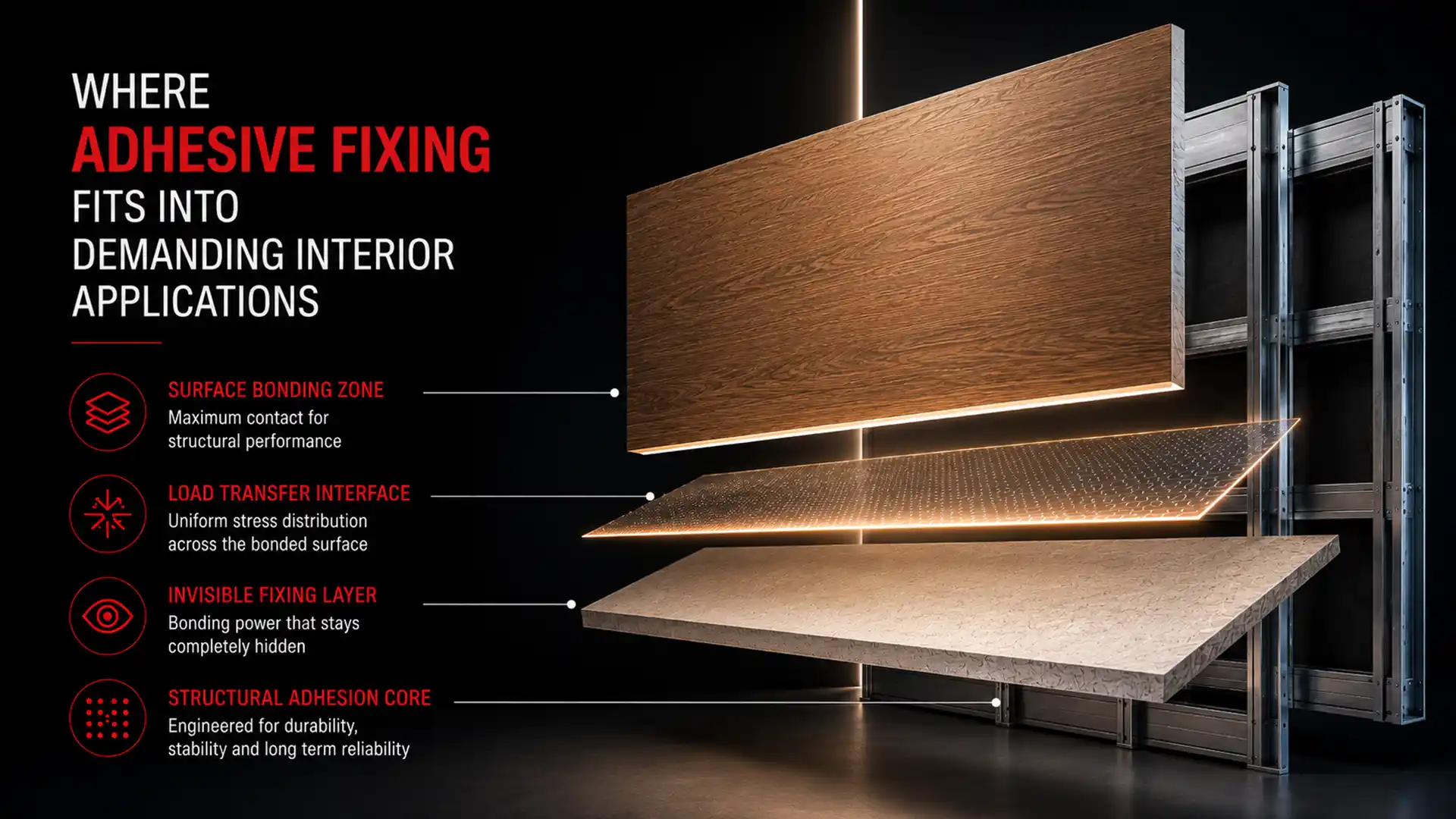
Where Adhesive Fixing Fits into Demanding Interior Applications
Interior projects increasingly combine decorative materials with tight installation schedules. Panels, mouldings, trims and selected architectural elements often need secure attachment without allowing fixing points to dominate the finished appearance. This is where Heavy Duty Construction Adhesive can have a practical role in suitable applications.
Buildwell approaches adhesive use with an application first mindset. A dependable product can contribute to cleaner detailing when it is selected for the right purpose and applied according to relevant product guidance.
Start with the component
Every interior element places different demands on its attachment. A lightweight trim may have very different requirements from a large decorative panel. Size, weight, shape, bonding area and position can influence how the component should be secured.
Buildwell encourages contractors to identify what the component needs before deciding how it should be fixed. For suitable applications, Heavy Duty Construction Adhesive can provide an alternative where concealed attachment and clean detailing are important.
When appearance matters
Interior design often depends on details that are meant to disappear. Visible screws can interrupt decorative patterns, trim lines and carefully composed surfaces. In high visibility areas, small fixing points may become noticeable once lighting falls across the finished installation.
Buildwell considers concealed attachment useful where the appearance of the finished element is a major design consideration. When the application permits it, Heavy Duty Construction Adhesive can help reduce visible mechanical fixing points and allow the decorative component to remain the focus.
The substrate comes first
Adhesive performance begins with the receiving surface. Dust, loose particles, contamination, unsuitable coatings and surface irregularities can influence bonding. The substrate also differs from project to project, so an adhesive should never be assumed to perform identically on every material.
Before application, Buildwell recommends checking the substrate condition and confirming compatibility with the intended product and component. For Heavy Duty Construction Adhesive, this assessment is especially important when dependable attachment is expected under demanding interior conditions.
Weight changes the fixing requirement
A component’s appearance does not always indicate how demanding its installation will be. A large decorative element can create different requirements depending on its weight, dimensions, shape and available bonding area.
Buildwell encourages project teams to assess these factors before selecting an adhesive based fixing method. Where recommended for the intended use, Heavy Duty Construction Adhesive can support suitable interior components while keeping the attachment visually discreet.
Site productivity and working control
Construction teams need materials that fit real site conditions. Installation may involve repeated work across rooms, floors or multiple areas. Working characteristics can influence positioning and productivity.
Buildwell considers site practicality alongside technical suitability. Speed should never become a reason to ignore application instructions.
High visibility areas need careful detailing
Hotel receptions, retail displays, corporate entrances, restaurants and feature areas often form part of the first impression of a building. In such spaces, inconsistent junctions or visible fixing points can distract from the intended design.
Buildwell recommends reviewing the fixing method carefully in these locations. Where the component and substrate are compatible, the adhesive can support cleaner visual detailing by keeping selected attachment points concealed.
Adhesive is not a shortcut
Adhesive based installation is not automatically simpler. The receiving surface still needs to be suitable. Components need accurate measurement and positioning, and application must follow the manufacturer’s recommendations.
Buildwell treats adhesive installation as a precision activity. Using the product correctly requires attention to the surface, instructions, component positioning and surrounding construction conditions. A discreet fixing method still deserves disciplined execution.
Mechanical fixing still has its place
Adhesive should not be treated as a universal replacement for mechanical fastening. Certain components, loads, substrates or project conditions may require screws, clips or other mechanical methods. In some applications, a combination of methods may also be appropriate.
Buildwell encourages professionals to evaluate the complete requirement before choosing a fixing approach. the adhesive is most useful when its characteristics match the application rather than when it is selected simply to avoid conventional fasteners.
Precision after product selection
Choosing the correct product is only one part of the process. Reference lines, measurements, component positioning and junction details should be established before installation begins.
Buildwell recommends preparing the installation carefully so the fixing process remains controlled from start to finish. Accurate positioning can contribute to cleaner transitions and consistent decorative detailing, particularly where several components need to align.
Application determines the value
There is no single fixing method that is ideal for every interior project. The most effective approach depends on the component, substrate, load, environment, accessibility, appearance and installation requirements.
Buildwell supports this practical way of evaluating materials. Where conditions are appropriate, Heavy Duty Construction Adhesive can become a useful part of an interior installation strategy, particularly when discreet attachment and efficient execution are important.
Conclusion
Adhesive based fixing has an important place in contemporary interior construction, but its effectiveness depends on using it where the application genuinely supports its use. Substrate compatibility, component weight, bonding area, positioning, environmental conditions and manufacturer guidance all need consideration before installation.
Buildwell encourages architects, contractors and interior professionals to evaluate the complete installation rather than the fixing product alone. In suitable applications, Heavy Duty Construction Adhesive can help achieve cleaner detailing while supporting an organised installation process.
Buildwell continues to provide products for modern interior construction where practical site requirements and refined design need to work together. With appropriate selection and disciplined application, adhesive based fixing can contribute to interiors that remain visually clean and carefully executed.
Contact Buildwell
Email: sales@buildwell.in
WhatsApp: 7900336699
Toll free: 1800 102 8031
Recent Posts
How gypsum boards can help create cleaner, more finished ceiling spaces