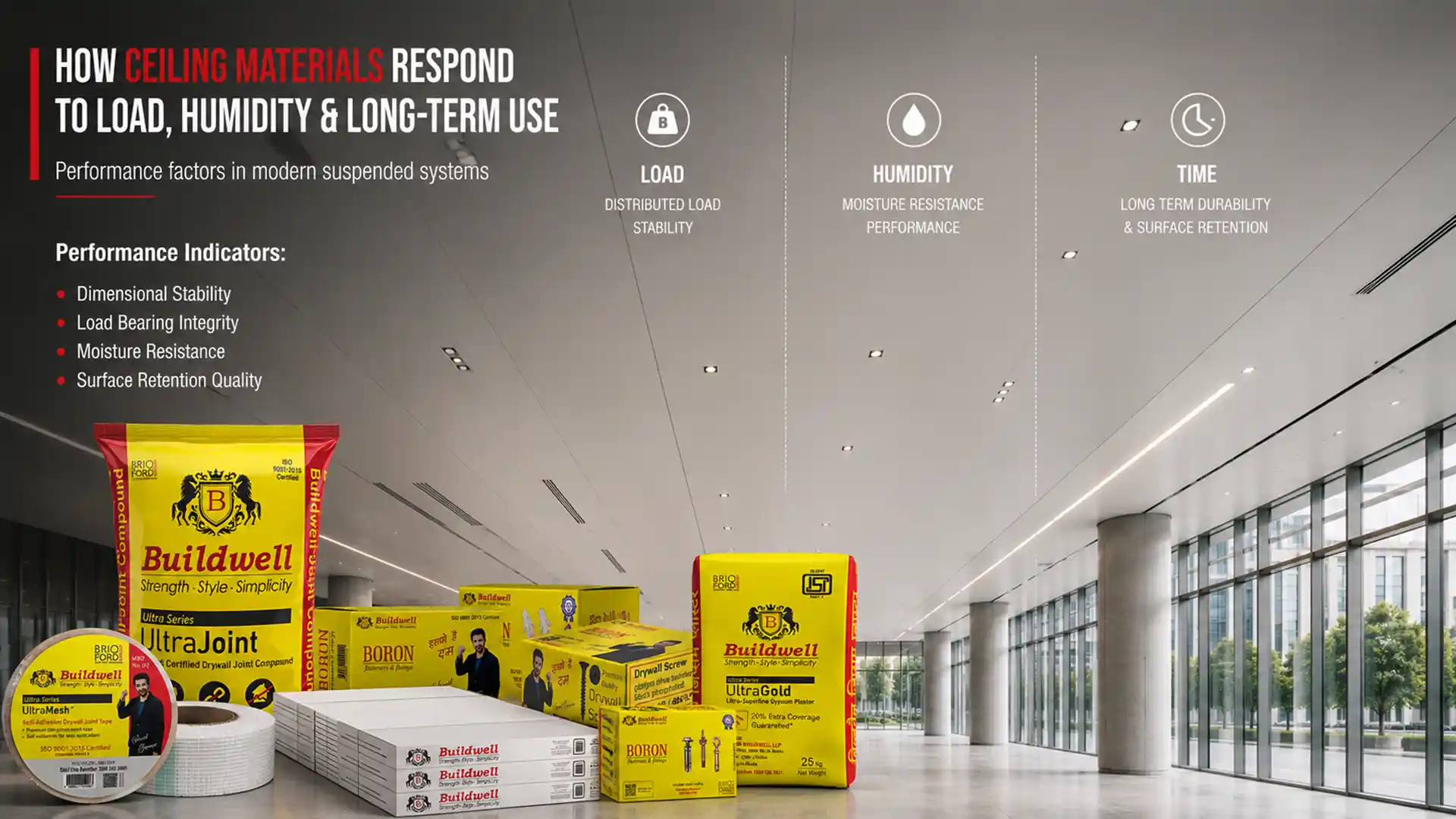
How ceiling materials respond to load, humidity, and long-term indoor usage conditions
A ceiling does not face pressure only during installation. Its real test begins after the project is completed and the space becomes active every day.
From constant air-conditioning and humidity changes to lighting heat, maintenance access, and structural movement, ceilings remain under continuous environmental stress throughout their lifespan. Some ceilings maintain their alignment and finish quality for years, while others slowly begin showing cracks, uneven joints, sagging sections, or surface inconsistency.
This difference usually comes down to how the materials respond to long-term indoor conditions.
At Buildwell, the focus is not just on creating ceilings that look clean during handover day. The goal is to help ceiling systems remain stable under practical indoor environments where usage conditions keep changing over time. That is why contractors and project consultants carefully evaluate Ceiling Materials based on durability, environmental adaptability, and long-term performance consistency.
Because ceilings are not decorative layers alone—they are working systems that continue reacting to their environment every single day.
Structural load slowly changes ceiling behaviour
Most people associate ceiling load only with board weight, but suspended ceiling systems carry much more pressure than that over time.
Lighting fixtures, HVAC vents, service openings, framing systems, maintenance access points, and environmental movement all create stress within the ceiling structure. Initially, this pressure may not appear visible, but long-term load imbalance gradually affects alignment and stability.
In large commercial interiors especially, ceiling systems remain under continuous operational stress. If the load is not distributed properly across the framing and support structure, the ceiling slowly begins reacting through minor movement and surface inconsistency.
Over time, this can lead to:
- Slight sagging across wider spans
- Stress concentration near joints
- Uneven surface reflection under lighting
- Reduced structural balance
Reliable Ceiling Materials help maintain dimensional stability under continuous pressure. Buildwell focuses on products designed for balanced structural behaviour instead of short-term visual appearance alone.
Because long-term ceiling performance depends heavily on how materials handle continuous structural stress.
Humidity affects more than just moisture exposure
Humidity is one of the most underestimated factors in ceiling performance.
Indoor spaces constantly experience changes in moisture levels depending on weather conditions, occupancy, ventilation, and HVAC usage. Kitchens, corridors, commercial spaces, and enclosed rooms all create different humidity conditions throughout the day.
This repeated moisture variation gradually affects how ceiling systems behave internally.
Some materials absorb and release moisture unevenly, creating stress within the ceiling layers. Initially, this may appear harmless, but over time it begins affecting:
- Surface smoothness
- Joint stability
- Alignment consistency
- Finishing appearance under lighting
In many projects, ceiling deterioration starts not because of installation failure, but because the materials were unable to handle long-term humidity variation properly.
Buildwell Develops Ceiling Materials designed for practical Indian indoor conditions where moisture levels fluctuate regularly. The focus remains on helping ceilings maintain dimensional balance despite environmental changes.
Because humidity never stops interacting with the ceiling after installation.
Air-conditioning and airflow influence ceiling stability
Modern interiors rely heavily on ventilation systems and air-conditioning. While these systems improve comfort, they also continuously affect ceiling behaviour.
Constant airflow changes pressure conditions across suspended ceilings. Over long periods, this repeated movement gradually influences:
- Board positioning
- Joint stress
- Surface vibration near vents
- Grid stability in wider ceiling spans
Poorly balanced systems often begin producing minor movement or sound around airflow zones. In commercial projects with continuous HVAC operation, these effects become even more noticeable over time.
Reliable Materials respond more predictably under continuous airflow exposure. Buildwell focuses on ceiling systems that maintain structural stability in actively ventilated environments instead of only controlled conditions.
Because ceilings operate under moving air every single day, not in static environments.
Lighting heat creates thermal movement across ceilings
Lighting affects ceilings in more ways than people realize.
Modern interiors use recessed lighting, spotlights, cove lighting, and decorative illumination systems that generate continuous localized heat. This repeated thermal exposure creates expansion and contraction cycles within ceiling materials.
At first, these movements are microscopic. But over years of operation, repeated thermal movement gradually creates:
- Surface stress
- Minor alignment variation
- Joint fatigue
- Reflection inconsistency under lighting
The problem becomes more visible in spaces where lighting remains active for long durations every day.
Buildwell focuses on Ceiling Materials designed for stable performance under thermal variation and practical indoor usage conditions.
Because ceilings are constantly reacting to heat, even when the movement is too small to notice immediately.
Indoor operational usage gradually affects ceiling appearance
Many people assume ceilings remain untouched after installation, but that is rarely true in active buildings.
Ceilings experience regular operational interaction through:
- Maintenance activity
- Service inspections
- Electrical repairs
- HVAC adjustments
- Lighting replacement work
Every time ceiling sections are opened or disturbed, stress develops around joints, edges, and fastening zones.
Over time, repeated handling may affect:
- Surface continuity
- Edge integrity
- Board alignment
- Joint durability
This is why operational durability matters as much as installation quality.
Reliable Ceiling Materials help maintain structural consistency despite repeated maintenance cycles. Buildwell develops systems designed for long-term usage conditions instead of temporary showroom appearance.
Because ceilings are functional systems that continue serving the building long after installation.
Joint areas react first to environmental stress
In almost every ceiling system, joints are the first areas where instability becomes visible.
Even when the rest of the ceiling appears stable, environmental stress usually concentrates around board transitions first. Humidity changes, structural movement, and thermal expansion all create pressure near joints over time.
This eventually leads to:
- Hairline cracks
- Visible joint lines
- Uneven reflection under directional lighting
- Surface separation in weaker areas
Joint durability depends heavily on how well the ceiling system absorbs long-term environmental movement.
Buildwell focuses on ceiling systems designed to reduce movement-related stress near transitions and sensitive finishing zones. Properly coordinated Ceiling Materials help maintain better visual continuity over extended operational periods.
Because joints reveal ceiling stress earlier than flat surfaces.
Large spaces magnify every small inconsistency
In smaller rooms, slight variation may remain unnoticed for years. In large commercial ceilings, however, even minor inconsistencies become highly visible.
Wide ceiling spans amplify:
- Structural movement
- Surface waviness
- Reflection inconsistency
- Environmental variation across different sections
Large offices, institutions, and commercial interiors often experience different airflow and humidity conditions within the same ceiling itself.
This creates uneven environmental exposure across the project.
Reliable Materials help maintain more stable behaviour across extended ceiling areas. Buildwell supports large-scale ceiling systems designed for long-term consistency under varied indoor conditions.
Because bigger ceilings expose every weakness more clearly over time.
Surface smoothness changes slowly with age
A freshly finished ceiling may appear perfectly smooth during handover, but long-term indoor exposure slowly changes surface behaviour.
Humidity, airflow, thermal movement, operational usage, and structural stress gradually influence:
- Surface texture
- Lighting reflection quality
- Finish consistency
- Visual smoothness under illumination
Many ceilings lose visual balance slowly rather than suddenly. This is why material quality must be judged based on long-term behaviour, not immediate appearance alone.
Buildwell focuses on Ceiling Materials designed for stable long-term finishing performance under real indoor operational environments.
Because true ceiling quality is measured years later—not immediately after installation.
Why experienced contractors focus on long-term material behaviour
Professional contractors and consultants do not evaluate ceiling systems only for installation convenience.
They carefully consider:
- Humidity adaptability
- Structural load response
- Airflow stability
- Thermal movement resistance
- Maintenance durability
- Joint performance over time
This complete-system approach helps improve:
- Ceiling lifespan
- Surface consistency
- Structural reliability
- Long-term visual appearance
Buildwell aligns with these professional expectations by focusing on ceiling systems designed for real-world operational performance.
Because professional ceiling quality depends on how materials behave after years of indoor usage—not only during installation.
Conclusion: Ceiling materials continuously respond to indoor conditions
Ceiling systems remain under constant environmental and operational pressure throughout their lifespan.
Structural load, humidity variation, airflow exposure, thermal movement, maintenance activity, and long-term indoor usage all gradually influence ceiling stability and appearance. Materials that cannot adapt to these conditions eventually begin showing visible deterioration and structural inconsistency.
Choosing reliable Ceiling Materials helps improve long-term ceiling stability, visual consistency, and operational durability across different project environments.
Buildwell continues supporting modern ceiling construction with products designed for practical indoor conditions, environmental adaptability, and reliable long-term performance. With a focus on structural balance and real-world operational behaviour, Buildwell helps create ceilings that remain visually smooth and structurally stable over extended periods of use.
Because ceiling performance is not tested during installation alone—it is tested every day afterward.
Contact Buildwell
📧 Email: sales@buildwell.in
💬 WhatsApp: 7900336699
📞 Toll-free: 1800 102 8031
Recent Posts
Where construction adhesive glue fits into modern interior installation work