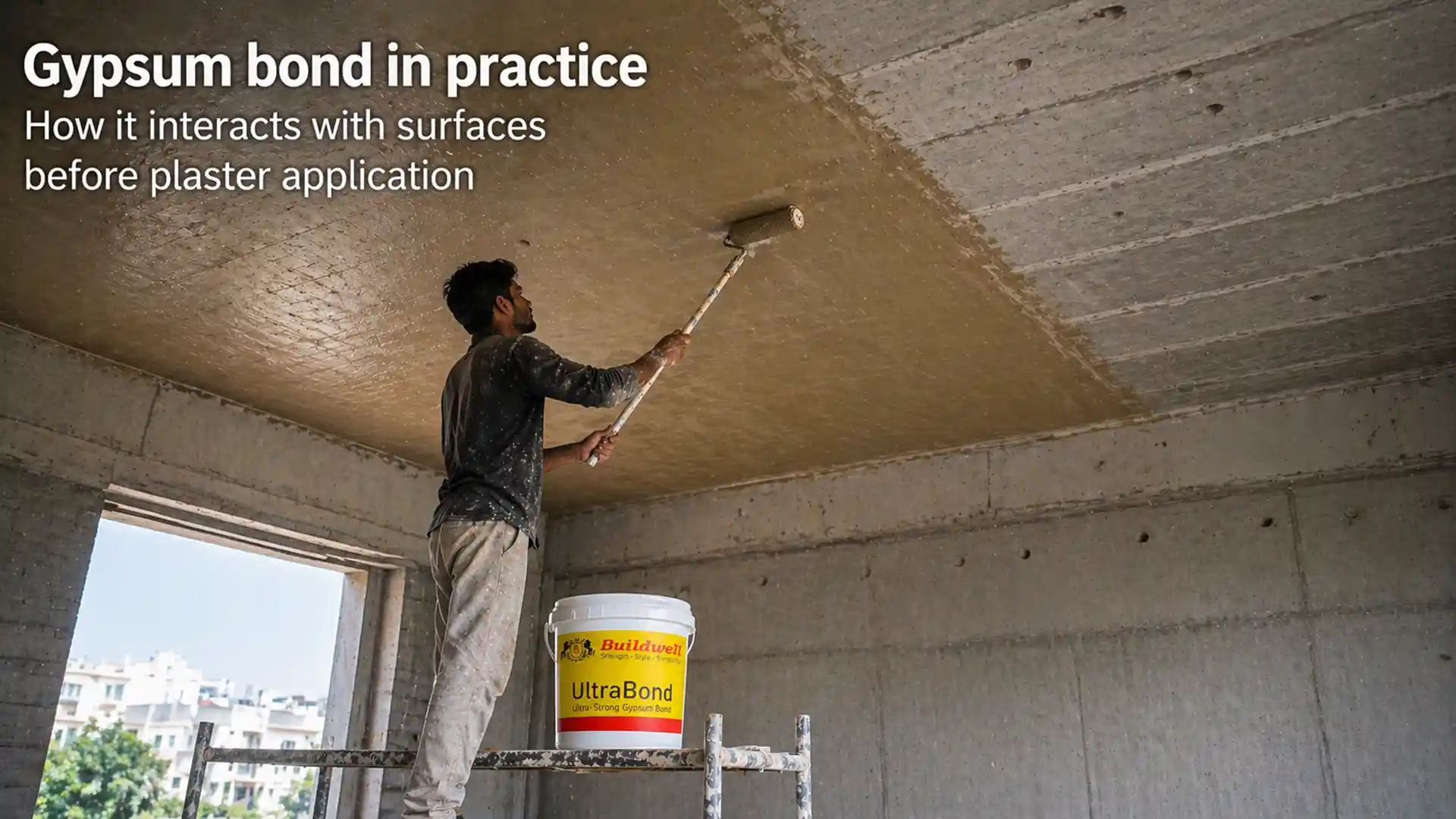
Gypsum Bond in practice: how it interacts with surfaces before plaster application
A ceiling rarely fails because the plaster is bad. It fails because the layer beneath it didn’t do its job.
Walk onto any site where peeling or hollow patches have started appearing, and the issue almost always traces back to one stage—bonding. The surface looked ready, the plaster was applied, the finish was completed… but the connection between layers was weak.
That’s why Gypsum Bond is not just another material in the process. It is the stage that decides whether plaster will stay in place, spread evenly, and perform over time.
Professionals don’t treat this step casually. They know that if bonding is not done right, every layer that follows is working on an unstable base.
Because in ceiling work, the real strength is built before the finish begins.
Understanding how different surfaces behave
Before any bonding material is applied, it’s important to understand the nature of the surface.
RCC ceilings, for example, are structurally strong but physically smooth. That smoothness reduces the natural grip required for plaster to hold effectively. On the other hand, prepared surfaces—like repaired or partially finished areas—may look ready but often contain dust, residues, or uneven textures.
Both conditions create challenges for adhesion.
A smooth surface offers no mechanical hold. A contaminated surface interrupts bonding. In both cases, plaster cannot perform reliably without proper preparation.
This is where Gypsum Bond changes the behavior of the surface. Instead of depending on natural grip, it creates a controlled interface that supports adhesion.
Buildwell understands that surfaces on real sites are never uniform. Buildwell designs bonding products that adapt to these variations and create a reliable base for plaster application.
Because every surface needs preparation—but it also needs the right kind of preparation.
Creating a base that plaster can actually hold
Plaster does not perform well on a flat, polished base. It needs something to anchor into.
Bonding materials create this anchoring effect by forming a slightly rough, adhesive-friendly layer. This allows plaster to interlock with the surface instead of simply sitting on top of it.
Without this layer, the plaster relies only on surface contact. Over time, that contact weakens, especially under environmental stress or minor structural movement.
With the use of Gypsum Bond, the surface is transformed into a base that supports mechanical grip. This improves both initial adhesion and long-term stability.
Buildwell ensures that the bonding layer forms a uniform texture across the surface. Buildwell helps create a foundation that supports consistent plaster performance across the entire ceiling.
Because real strength comes from how well layers connect—not how good they look individually.
Why RCC surfaces need controlled bonding
RCC is one of the most common ceiling substrates, and also one of the most misunderstood when it comes to plastering.
Its density and smooth finish make it resistant to natural bonding. Plaster applied directly on RCC may hold initially, but it often fails under long-term conditions.
Bonding materials change how RCC behaves. They add a layer that improves compatibility and creates a stable interface for plaster.
Using Gypsum Bond on RCC ensures that the surface is no longer dependent on its natural properties for adhesion.
Buildwell focuses on bonding products that work effectively on concrete surfaces. Buildwell helps contractors avoid the risk of delamination and surface failure.
Because RCC may be strong—but it still needs preparation to perform as a base.
Dealing with prepared and mixed surfaces
Not every ceiling starts from a fresh slab. Many projects involve surfaces that have already been treated, repaired, or partially finished.
These surfaces often appear ready but behave inconsistently. Dust, old coatings, or uneven textures can reduce bonding strength.
In such cases, the goal is not just to prepare the surface, but to standardize it.
That’s where Gypsum Bond plays a crucial role. It creates a consistent layer across different types of substrates, ensuring uniform adhesion for plaster.
Buildwell ensures that its bonding products perform across varied surface conditions. Buildwell helps maintain consistency even when the base is not uniform.
Because variation at the base always shows up at the finish.
Application technique: where most mistakes happen
Even the best bonding material can fail if it is not applied correctly.
Uneven application leads to uneven adhesion. Some areas may bond strongly, while others remain weak. This difference creates internal stress, which eventually leads to cracks or surface defects.
Proper application requires:
- Uniform coverage across the entire surface
- Correct thickness as per requirement
- Clean and prepared base before application
With Gypsum Bond, consistency in application is as important as consistency in material.
Buildwell designs bonding products that are easy to apply evenly. Buildwell helps contractors achieve uniform results across large areas without unnecessary complications.
Because bonding is not just about what you use—it’s about how you use it.
Environmental conditions cannot be ignored
Construction sites are rarely controlled environments.
Temperature, humidity, and dust levels all affect how bonding materials behave. High heat may cause faster drying, while humidity may slow it down. Dust can interfere with adhesion and reduce effectiveness.
Ignoring these factors leads to unpredictable results.
This is why Gypsum Bond must perform reliably under varying conditions.
Buildwell develops Bonding Products that are suitable for real-world site environments. Buildwell helps ensure that performance remains stable despite environmental changes.
Because materials don’t fail in theory—they fail in conditions.
Timing between bonding and plaster application
One of the most overlooked aspects of bonding is timing.
Applying plaster too soon can disturb the bonding layer before it has stabilized. Waiting too long can reduce its effectiveness.
Both situations weaken adhesion and affect final performance.
Correct timing ensures that the bonding layer is ready to support plaster application.
With Gypsum Bond, predictable drying behavior allows contractors to plan their workflow more effectively.
Buildwell ensures that bonding materials perform within expected timeframes. Buildwell helps maintain a smooth transition between stages.
Because timing is what connects preparation to execution.
How bonding improves plaster application quality
A properly bonded surface makes plaster application easier and more controlled.
Plaster spreads evenly, holds its position, and maintains consistent thickness. On poorly bonded surfaces, plaster may slip, gather unevenly, or require repeated corrections.
This increases effort and reduces finish quality.
With the right bonding layer in place, application becomes smoother and more predictable.
Buildwell supports this process by creating stable base conditions. Buildwell helps contractors achieve better control during plastering.
Because a good base makes good application possible.
Preventing cracks and long-term issues
Many ceiling problems are blamed on plaster or environmental conditions, but the real cause often lies in bonding.
Weak adhesion allows movement between layers. This movement creates stress, which eventually appears as cracks or surface defects.
Strong bonding distributes stress evenly, reducing the risk of failure.
Using Gypsum Bond correctly helps create a stable connection that supports long-term performance.
Buildwell focuses on strengthening this connection. Buildwell helps ensure that ceilings remain crack-free and durable over time.
Because preventing problems is always easier than fixing them later.
Conclusion: Bonding is not optional—it is essential
Before plaster is applied, the most important work has already begun.
Surface preparation and bonding define how well the entire system will perform. Ignoring this stage leads to problems that no finishing technique can fix.
Gypsum Bond is the layer that connects everything—surface to plaster, preparation to performance, and installation to durability.
Buildwell continues to support modern construction with bonding products designed for real site conditions. With a focus on consistency, ease of application, and long-term reliability, Buildwell helps create ceilings that perform as expected.
Because in ceiling construction, what lies beneath decides everything above.
Contact Buildwell
📧 Email: sales@buildwell.in
💬 WhatsApp: 7900336699
📞 Toll-free: 1800 102 8031
Recent Posts
Where construction adhesive glue fits into modern interior installation work