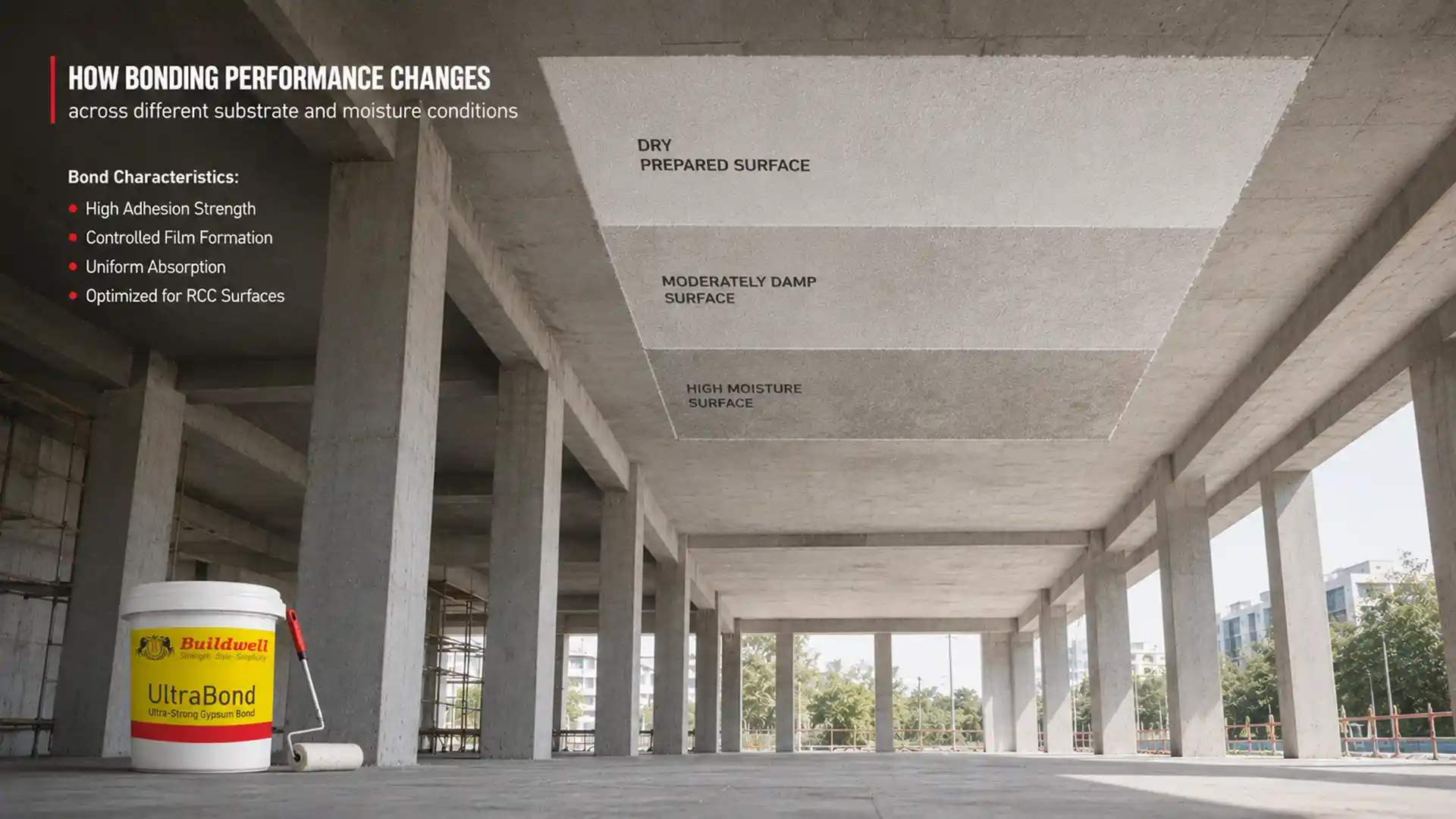
How bonding performance changes across different substrate and moisture conditions
In ceiling finishing work, plaster performance depends heavily on what happens before plastering even begins. A smooth final surface may look perfect initially, but if the bonding layer behaves inconsistently beneath it, long-term defects slowly begin appearing.
This is why substrate condition matters so much.
Different ceiling surfaces react differently during bonding application. RCC slabs, repaired patches, old surfaces, and moisture-affected areas all create different adhesion conditions. The same bonding layer may behave very differently depending on absorption level, surface texture, and environmental exposure.
At Buildwell, the focus is on preparing ceilings for stable plaster performance under real project conditions. That is why contractors evaluate Gypsum Bond not only for adhesion strength, but for how consistently it responds across varying substrate and moisture conditions.
Because strong plaster performance always starts with controlled bonding behaviour.
Smooth RCC surfaces reduce natural plaster grip
One of the biggest bonding challenges in modern construction comes from smooth RCC ceilings.
Concrete surfaces often appear solid and clean, but their smooth texture reduces natural grip for plaster. If plaster is applied directly onto untreated RCC, adhesion remains weak and unstable over time.
Initially, the surface may appear acceptable. But long-term exposure to environmental movement eventually creates:
- Hollow patches
- Weak plaster hold
- Surface separation
- Localized peeling
This happens because smooth RCC does not create enough mechanical grip for stable plaster attachment.
A properly applied Gypsum Bond creates an intermediate textured layer between RCC and plaster. This improves adhesion consistency and helps plaster attach more uniformly across the ceiling surface.
Buildwell focuses on bonding products designed for controlled grip development across smooth substrates.
Because strong ceilings require more than surface contact—they require stable adhesion.
Rough surfaces change bonding absorption behaviour
Not all substrates are smooth.
Some ceilings contain rough concrete, repaired patches, exposed aggregate sections, or uneven surface texture caused by previous site corrections. These surfaces absorb bonding materials differently compared to polished RCC.
Rough surfaces may:
- Pull moisture too quickly
- Create uneven drying patterns
- Cause variable bonding thickness
This affects how plaster behaves later during application and curing.
If bonding response becomes inconsistent across rough areas, the ceiling may eventually show:
- Surface tone variation
- Uneven plaster texture
- Localized adhesion differences
Properly applied Gypsum Bond helps regulate interaction between rough substrates and plaster layers.
Buildwell supports more controlled bonding behaviour across uneven ceiling conditions.
Because substrate texture directly influences bonding performance.
Dust and loose particles weaken bonding stability
One of the most common on-site problems is applying bonding layers over contaminated surfaces.
Dust, loose cement particles, and construction residue interfere with proper adhesion. Even when the surface looks visually clean, fine particles may still prevent bonding products from attaching directly to the substrate.
This creates weak bonding zones beneath the plaster.
Over time, these areas become vulnerable to:
- Surface cracking
- Hollow sound patches
- Reduced plaster hold
Good surface cleaning is critical before applying Gypsum Bond.
Buildwell emphasizes preparation discipline before bonding application begins. Proper substrate cleaning helps bonding products interact directly with the ceiling surface instead of loose contaminants.
Because bonding layers can only perform properly when they connect directly to the substrate.
Moisture conditions heavily affect bonding response
Moisture is one of the most important factors influencing bonding behaviour.
Different ceilings contain different moisture levels depending on:
- Environmental humidity
- Recent curing activity
- Water exposure history
- Airflow conditions
Excessive moisture affects how bonding layers settle and cure.
If bonding is applied over overly damp surfaces, it may:
- Dry inconsistently
- Lose uniform grip strength
- Create unstable plaster interaction later
At the same time, extremely dry surfaces may absorb moisture too aggressively, reducing bonding consistency.
Properly applied Gypsum Bond helps stabilize moisture interaction between the substrate and plaster layer.
Buildwell develops Bonding Products suited for practical Indian site conditions where moisture variation is common.
Because moisture imbalance changes how bonding layers behave beneath the surface.
Environmental humidity influences curing behaviour
Even after bonding is applied, environmental conditions continue affecting performance.
Humidity changes how quickly moisture leaves the bonding layer. In humid conditions, curing slows down. In hot and dry conditions, bonding layers may dry too quickly before stabilizing properly.
This affects:
- Adhesion development
- Surface consistency
- Long-term plaster stability
Inconsistent curing often creates invisible weakness beneath the final finish.
Reliable Gypsum Bond performance depends on balanced curing behaviour under different environmental conditions.
Buildwell focuses on products designed to perform consistently across varying humidity levels and changing weather exposure.
Because environmental conditions influence bonding long after application.
Repaired areas behave differently from original surfaces
Most large ceiling projects contain repaired or corrected sections.
These repaired zones usually absorb bonding products differently from original concrete areas. Some repaired patches become highly absorbent, while others remain comparatively dense.
This creates variation in:
- Bonding thickness
- Drying speed
- Adhesion stability
Without proper bonding coordination, repaired areas eventually become visible through:
- Tone variation
- Surface inconsistency
- Different plaster curing behaviour
Proper application of Gypsum Bond helps create more balanced surface response across repaired and original areas.
Buildwell supports consistent bonding behaviour throughout mixed substrate conditions.
Because repaired surfaces should not behave differently from surrounding areas.
Bonding consistency affects plaster application flow
The way bonding layers perform directly influences plaster application.
If bonding response varies across the ceiling, plaster begins reacting differently from section to section. Some areas may allow smooth spread, while others create drag or uneven hold.
This eventually affects:
- Surface smoothness
- Thickness consistency
- Reflection quality under lighting
Stable bonding creates smoother plaster workability during application.
Properly functioning Gypsum Bond improves coordination between the preparation stage and plastering stage.
Buildwell focuses on products that help maintain predictable plaster interaction during real site execution.
Because smooth finishing depends heavily on stable bonding beneath it.
Temperature variation changes bonding performance over time
Ceilings continuously experience thermal expansion and contraction.
Daily temperature changes influence how bonding layers behave beneath plaster surfaces. If bonding remains weak or inconsistent, these thermal movements gradually create stress between layers.
Over time, this may lead to:
- Hairline cracks
- Surface separation
- Reduced adhesion stability
Balanced bonding performance helps distribute thermal stress more evenly throughout the ceiling.
Reliable Gypsum Bond improves long-term surface stability under changing environmental conditions.
Buildwell supports bonding systems designed for real operational environments instead of ideal laboratory conditions.
Because long-term ceiling durability depends on stable internal layer connection.
Large ceiling areas require consistent bonding behaviour
In smaller ceilings, minor bonding variation may remain unnoticed. In large commercial or institutional ceilings, inconsistency becomes much more visible.
Uneven bonding behaviour across larger surfaces creates:
- Variable plaster curing
- Reflection inconsistency under lighting
- Surface texture variation
Maintaining uniform bonding response across extended ceiling areas is critical for visual consistency.
Buildwell focuses on products designed for large-scale project stability. Properly coordinated Gypsum Bond application helps maintain balanced ceiling behaviour across wide surfaces.
Because larger ceilings magnify every inconsistency.
Why professionals prioritize bonding preparation carefully
Experienced contractors understand that plaster quality alone cannot guarantee long-term performance.
They focus heavily on:
- Surface cleanliness
- Moisture balance
- Substrate absorption behaviour
- Environmental conditions during application
- Proper bonding consistency across all areas
This preparation process significantly improves ceiling durability and finish quality.
Buildwell aligns with these professional practices by supporting reliable bonding performance across varied project conditions.
Because professionals know that ceiling strength begins beneath the plaster layer.
Conclusion: Bonding behaviour changes with every surface condition
No two ceiling surfaces behave exactly the same.
Smooth RCC, rough patches, repaired zones, dust contamination, humidity exposure, and thermal variation all influence how bonding layers perform before plaster application.
Ignoring these factors leads to weak adhesion, uneven curing, surface instability, and reduced finishing durability over time.
Proper use of Gypsum Bond helps create stable surface conditions that improve plaster adhesion, application consistency, and long-term ceiling performance.
Buildwell continues to support modern ceiling construction with bonding products designed for real-world substrate and moisture conditions. With a focus on adhesion control, environmental adaptability, and practical site execution, Buildwell helps create ceilings that remain stable and visually consistent over time.
Because in ceiling finishing, long-term strength always begins at the bonding layer.
Contact Buildwell
📧 Email: sales@buildwell.in
💬 WhatsApp: 7900336699
📞 Toll-free: 1800 102 8031
Recent Posts
How PVC panel sheets for walls simplify decorative interior finishing