Ceiling Material Failures in Indian Projects: What the Best Performing Sites Do Differently
You don’t need a cracked ceiling to know something went wrong — sometimes, the biggest failures start silent. A faint sag in the center of the tile. A plaster line that looks “off” under light. A hairline split that widens with every temperature shift. And if you’ve been on enough Indian job sites, you’ve seen it all before.
Contractors will often blame the execution team. Execution blames poor finishing. But rarely do they look at the root of the problem: mismatched, low-quality, or climate-incompatible Ceiling Materials.
Truth is, the best-performing sites across India aren’t just using “premium” products — they’re using the right ones, in the right combination, and applying them in the right order. Here’s how they’re doing it differently — and what you can learn from their playbook.
Problem 1: Materials That Look Good in Showrooms But Fail on Site
Many procurement decisions are made on showroom visits, presentations, or online catalogs. Everything looks promising under perfect lighting and air conditioning. But Indian job sites are anything but.
Humidity in Kolkata, dry heat in Ahmedabad, monsoon-level moisture in Mumbai — every climate affects Ceiling Materials differently. Tiles that passed a lab test might warp on-site. Plasters that felt smooth in a demo might bubble when applied on a high-exposure RCC surface.
What top-performing projects do differently:
They demand site trials. Before bulk ordering, they test how the material behaves during mixing, application, drying, and finishing. Buildwell is one of the few brands that actively supports sample applications and technical evaluations on real sites — and that’s a key reason it’s preferred in high-stakes projects.
Problem 2: Mixing Brands Without Compatibility Testing
You’d be surprised how often projects use gypsum boards from one brand, screws from another, a local bonding agent, and unknown tape — all hoping it’ll “just work.” Spoiler: it doesn’t.
Ceiling failures often begin at the joints — where different materials meet but don’t cooperate. A board expands, the screw loosens, the bond fails — and the finish follows.
What the best sites do:
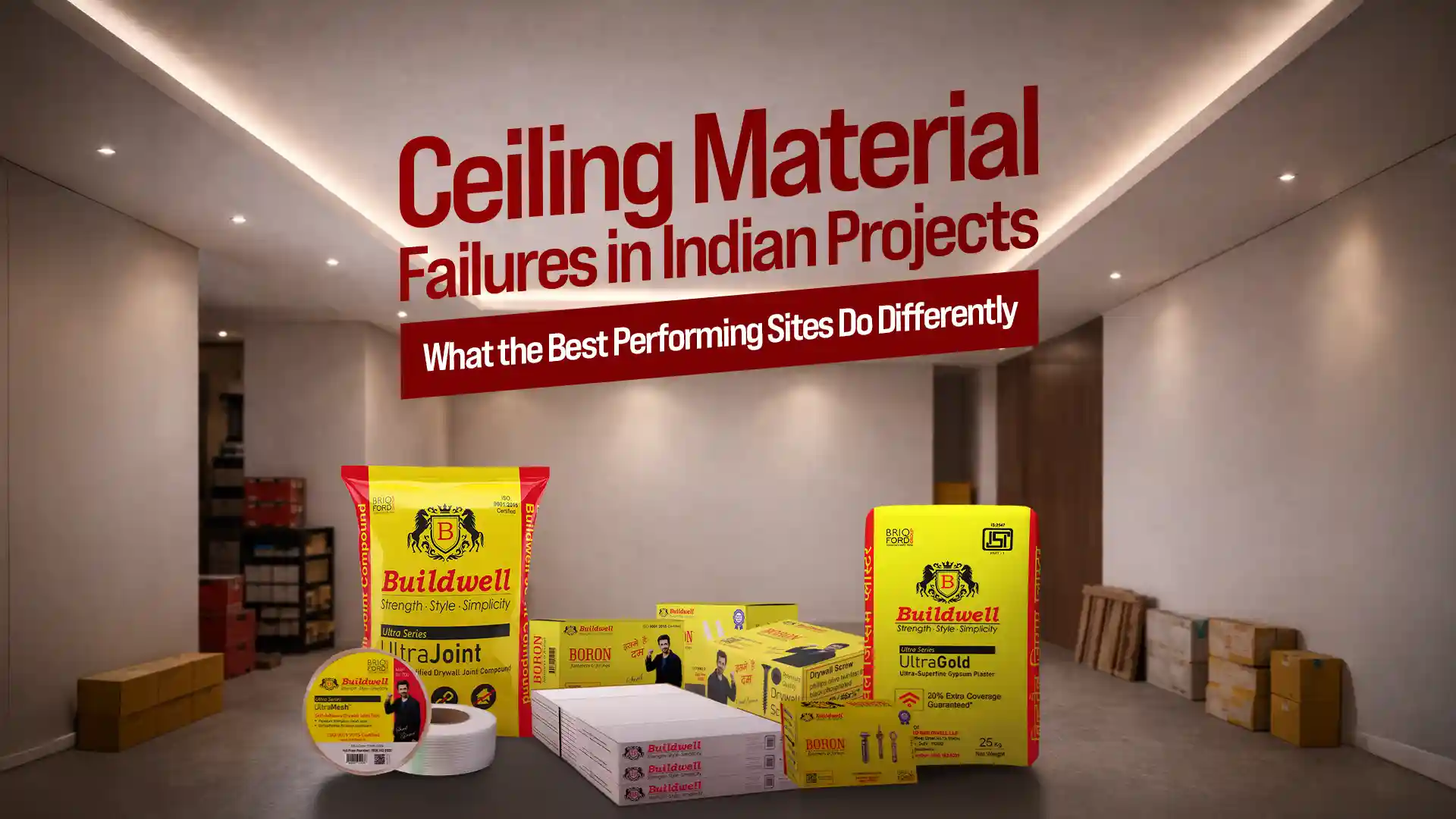
They use an ecosystem approach. Buildwell, for example, doesn’t just sell Ceiling Materials — it offers a full range of system-compatible products: gypsum plaster, jointing compounds, boards, tapes, screws, and bonding agents. When these are designed to work together, installation becomes smoother, and failure rates drop.
Problem 3: Skipping Technical Sheets and Assuming “It’ll Work”
This is common in fast-moving projects or when working with small-time applicators. The assumption is that all plasters apply the same, all tiles fit the grid, and all tapes seal cracks.
But not all Ceiling Materials are made for the same use cases. Some need thinner coats. Some require a specific bonding agent. Others are only meant for dry areas, not semi-exposed corridors.
What successful sites do differently:
They follow the tech sheets. From trowel size to coat thickness to drying time — these are not optional suggestions. They’re performance instructions. Buildwell’s packaging and training support ensure that execution teams apply exactly as intended. That’s how premium finish is maintained.
Problem 4: Prioritizing Speed Over Strength
It’s tempting to choose the fastest drying plaster or the lightest tile. But speed at the cost of stability is never a win.
Quick-dry plasters often don’t give enough open time for proper feathering. Lightweight tiles can rattle with air pressure or bend under load. Screws that drill fast might rust in six months.
What reliable contractors do:
They pick balanced Ceiling Materials — products optimized for both workability and strength. For example, Buildwell ceiling tiles are tested not just for look but for load resistance, moisture absorption, and edge integrity. These specs matter — especially on ceilings that carry lighting, fans, or HVAC grills.
Problem 5: No On-Site Training or Application Guidance
Even the best materials fail in the wrong hands. An improperly mixed plaster, uneven screw spacing, or wrong tape application can lead to callbacks, delays, and angry clients.
Good suppliers don’t just sell — they educate. Buildwell frequently sends trainers or guides for large sites, helping applicators understand how to apply its Ceiling Materials properly.
The result? Fewer execution errors, smoother finishes, and longer-lasting ceilings.
Problem 6: Poor Ceiling Design Planning at Procurement Stage
Sometimes the material is fine — but it’s the planning that’s flawed. Using ceiling boards in a space where you should’ve used tiles. Installing tiles in high-humidity areas without anti-sag properties. Using standard screws where high-hold fasteners were needed.
Top project managers involve technical experts early — ideally before material is ordered. That way, you pick Ceiling Materials based on load, location, maintenance needs, and aesthetics — not just on cost or availability.
What Buildwell-Supported Sites Are Doing Differently
When Buildwell partners with contractors, it doesn’t just deliver boxes. It offers a system. Here’s what you’ll typically see on Buildwell-equipped projects:
- Integrated material usage: Boards, plaster, jointing compound, fasteners — all from the same ecosystem.
- Trained applicators: Teams that understand mixing ratios, application methods, and curing time.
- Tech support: Real-time guidance via WhatsApp, call, or even site visits.
- Material reliability: Products engineered for Indian climates, not generic international specs.
That’s why Buildwell is becoming the go-to brand in large residential, commercial, and infrastructure ceiling projects.
What to Do Before Your Next Procurement
If you’re evaluating ceiling vendors for your next project, ask the following:
- Can they provide product test reports?
- Are their products tested for humidity, heat, and dust?
- Is the packaging site-friendly?
- Do they offer application support?
- Are their Ceiling Materials designed to work together?
If the answer to all five is yes — and if the brand is Buildwell — you’re already reducing your risk of failure by a mile.
Final Thought: In Ceilings, You Don’t Get a Second Shot
Once the ceiling goes up, it hides everything — your mistakes included. That’s why Ceiling Materials must be chosen with performance in mind, not just price.
Cracks, sag, discoloration, or client complaints — they all trace back to one thing: material choice.
The best-performing Indian projects know this. And that’s why they trust brands like Buildwell — engineered not just for looks, but for what happens after handover.
Want materials that actually perform across real Indian sites? Let’s talk.
💬 WhatsApp: 7900336699
📞 Toll-Free: 1800 102 8031