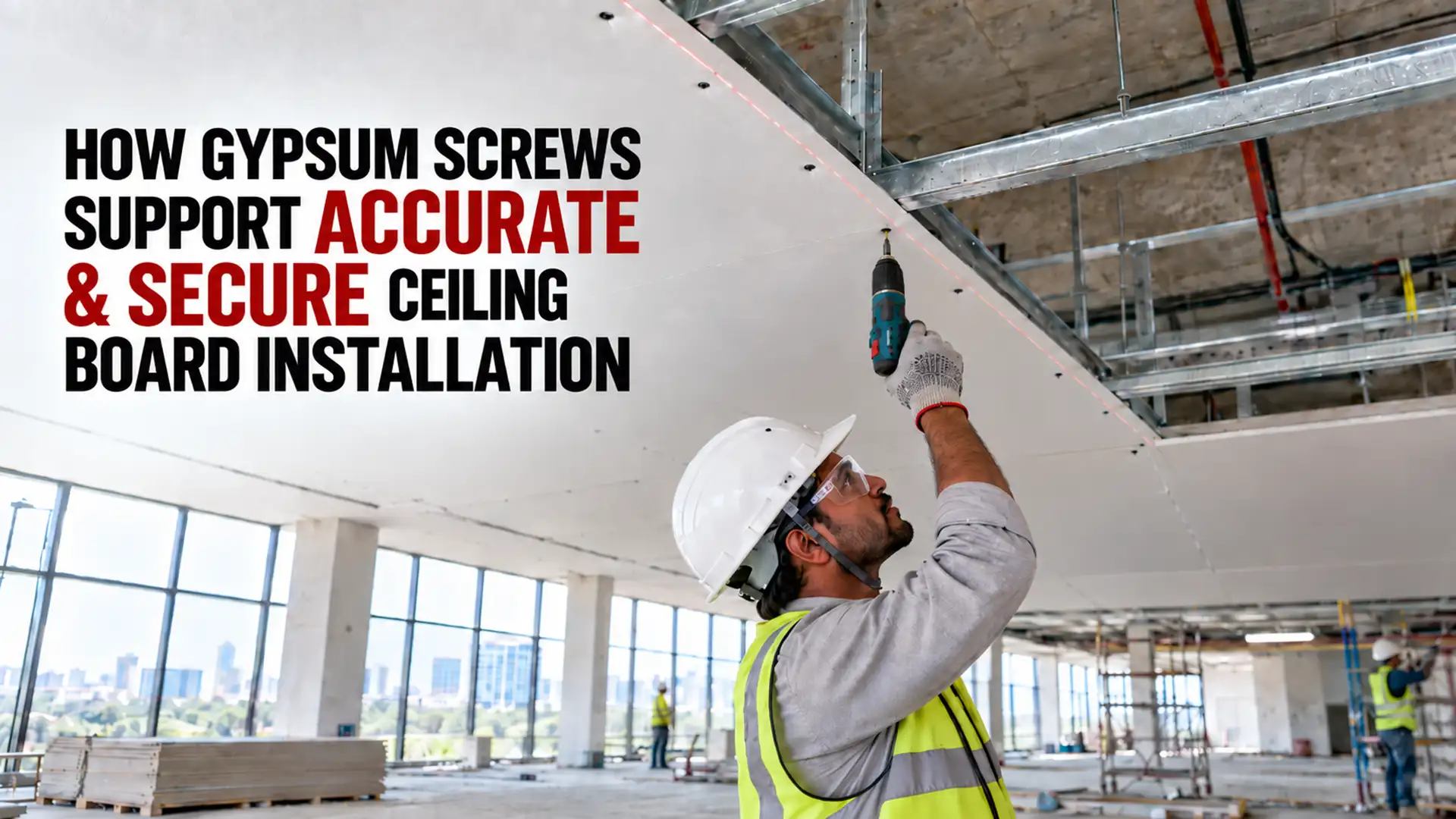
How gypsum screws support accurate and secure ceiling board installation
A ceiling board installation depends on hundreds of small fixing points working together. Each screw needs to enter the supporting frame correctly, hold the board in position and allow the surface to move through subsequent finishing stages without unnecessary disruption. Gypsum Screw selection therefore becomes an important part of planning a consistent ceiling installation. The quality of the final surface is influenced not only by the board and framing but also by how accurately the fixing process is carried out.
For contractors and installers, a reliable fixing method begins with understanding the relationship between the board, supporting framework and screw. Buildwell includes gypsum screws within its ceiling and fixing product range, giving project teams an option to consider when planning board installation alongside other compatible components.
Start with the fixing pattern
Before the first screw is driven, the fixing arrangement should be planned according to the requirements of the selected ceiling system. Board dimensions, framing positions, edges and joints all influence where fixing points need to be established.
A planned pattern helps installers maintain consistency across the complete installation instead of deciding fixing positions individually as the work progresses.
This is particularly important when Gypsum Screw fixing is repeated across large ceiling areas because small variations can become more noticeable when multiplied across the installation.
The supporting frame provides the reference
A screw needs to engage with the appropriate supporting member. Accurate framing therefore provides an essential reference for board fixing.
Before boards are installed, the alignment and positioning of the supporting system should be checked. If framing is inconsistent, accurate screw placement becomes more difficult.
Buildwell ceiling range includes framing components such as channel systems and T Grid systems, allowing contractors to consider the supporting structure and fixing components as part of the same installation plan.
Board positioning comes before fastening
A screw cannot correct an incorrectly positioned board. The board needs to be aligned properly before fixing begins.
Installers should check the intended position and ensure that the sheet sits appropriately against the supporting structure. Once the board is correctly positioned, fixing can proceed according to the recommended installation method.
This sequence helps maintain cleaner joints and reduces the possibility of unnecessary repositioning later.
Driving depth needs control
The way a screw is driven into the board can influence the finished surface. Excessive driving may damage the board surface while insufficient engagement may prevent the intended fixing arrangement from being achieved.
Controlled tool handling is therefore important. Installers should use an appropriate driving method and follow the recommendations applicable to the selected screw and ceiling system.
For Gypsum Screw installation, consistency in driving depth becomes particularly valuable when hundreds of fixing points are involved.
Head position affects finishing
The screw head should sit appropriately in relation to the board surface so that subsequent finishing work can be carried out properly.
If the head remains too prominent, it may interfere with finishing. If it is driven too deeply, the board surface may be affected.
The installer therefore needs to maintain a consistent approach rather than relying on excessive force. Buildwell fixing products can be considered within a complete ceiling installation process where board fixing and finishing are planned together.
Spacing creates consistency
The distance between fixing points contributes to the overall fixing pattern. Consistent spacing makes the installation easier to inspect and helps maintain a systematic working process.
Installers should follow the requirements of the specific ceiling system rather than applying a generic spacing pattern to every project.
When Gypsum Screw fixing is planned systematically, teams can move across the ceiling with a repeatable method instead of repeatedly stopping to determine where the next fixing point should be placed.
Tool selection influences accuracy
The screw and driving tool need to work together. Appropriate tool settings and handling can help the installer control the driving process and maintain consistent results.
Excessive speed or pressure can make it harder to control the screw as it enters the board and supporting frame.
A measured installation approach allows the installer to focus on both fixing security and the condition of the board surface.
Large projects need a repeatable workflow
On a small installation, inconsistencies may be easier to identify and correct. Larger ceiling projects require a more organised workflow because the same fixing operation is repeated across many sections.
Teams can divide the work into manageable areas and establish a consistent sequence for positioning, fastening and inspection.
This approach supports productivity without encouraging rushed installation. With Buildwell materials, the fixing process can be planned alongside boards, framing and related ceiling accessories.
Joints require careful coordination
Board joints should be considered when establishing the fixing arrangement. The edges of adjoining boards need appropriate support and fixing according to the installation requirements.
A poorly coordinated fixing layout can create additional finishing challenges later.
Planning joints and fixing positions together helps installers maintain a more coherent board arrangement and provides a better foundation for joint treatment.
Cutting and openings change the fixing layout
Ceiling boards often need to accommodate lighting points, service openings or other planned features. These interruptions can change the available fixing area and need to be considered before installation.
Marking openings accurately reduces the risk of unnecessary cutting or poorly positioned fixing points.
For Gypsum Screw applications, this coordination between board layout, services and framing helps maintain a more organised installation process.
Storage also matters
Fixing components need to remain protected and organised before they reach the installation point. Screws should be stored according to appropriate handling requirements and kept accessible to the installation team.
Organised storage can reduce interruptions when installers move between different sections of the ceiling.
It also helps teams identify the intended fastener quickly when several fixing products are present on the same site.
Inspection should continue throughout the work
Checking the installation as it progresses is more effective than waiting until the entire ceiling has been completed. Installers can review board positioning, screw placement and surface condition section by section.
Early inspection makes it easier to identify inconsistencies before they are covered by subsequent finishing work.
This is where Gypsum Screw selection and installation technique come together. The screw needs to perform its intended fixing role while the installer maintains control over the complete board installation.
Finishing reveals fixing consistency
Once boards are fixed, joint treatment and surface finishing begin to reveal whether the installation has been handled consistently.
Incorrectly positioned or excessively driven screws can create additional finishing requirements. Consistent fixing helps provide a more predictable base for the next stage.
Buildwell Ceiling Product range includes related materials such as jointing compound and jointing tape, allowing the finishing process to be considered alongside the board and fixing stages.
Matching the screw to the application
Fastener selection should always consider the intended ceiling system and compatible materials. A screw should not be selected solely because it appears similar to another fastener.
Length, head design, thread characteristics and application requirements all need to be considered according to the manufacturer’s recommendations.
For contractors, understanding the intended role of a Gypsum Screw can help prevent unsuitable substitutions during procurement or installation.
Accuracy supports more than fixing security
A screw performs a basic mechanical function, but its placement can also influence the efficiency of the finishing process. Accurate fixing supports consistent board positioning and reduces unnecessary corrections.
This makes the fixing stage part of the overall surface preparation process rather than a separate task.
When Buildwell ceiling materials are planned as a coordinated system, boards, framing, screws and finishing products can be considered together from the beginning.
A controlled fixing process creates consistency
Accurate ceiling installation comes from repeating the right process across every section. The frame needs to be aligned, boards need to be positioned correctly and screws need to be driven with controlled pressure and appropriate spacing.
Gypsum Screw fixing supports this sequence by providing the mechanical connection between the board and supporting structure.
For contractors and installers, the objective is not simply to complete the highest number of fixing points in the shortest time. It is to establish a consistent process that supports secure installation and a clean foundation for subsequent finishing.
Contact Buildwell
Email: sales@buildwell.in
WhatsApp: 7900336699
Toll free: 1800 102 8031
Recent Posts

How gypsum screws support accurate and secure ceiling board installation