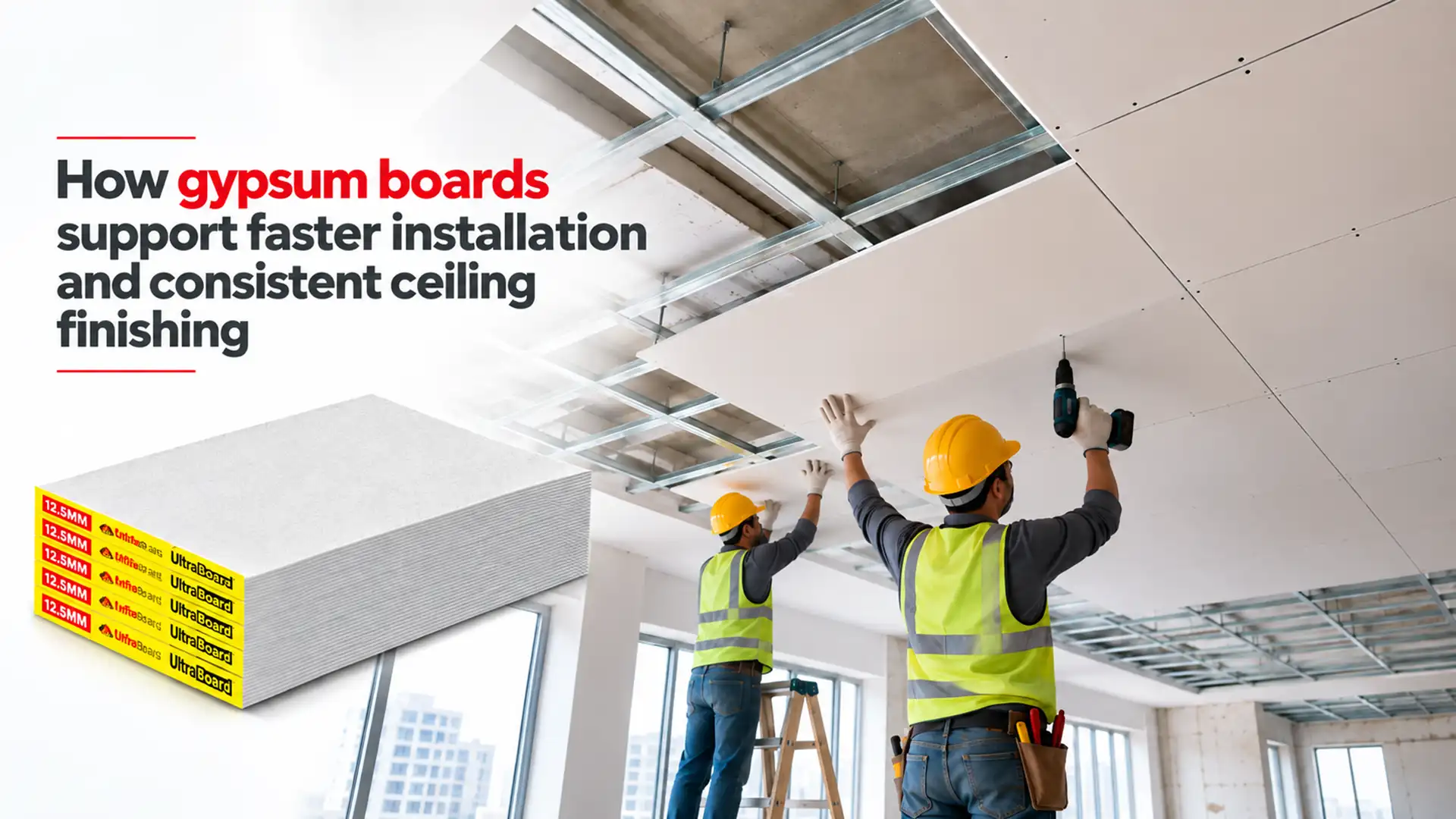
How gypsum boards support faster installation and consistent ceiling finishing
Ceiling installation becomes easier to manage when the material, framing system and work sequence are planned together. Gypsum Boards provide a structured sheet format that can support organised installation across different interior projects. Their consistent dimensions allow installers to plan layouts, handle repeated fixing and move progressively from one section to another while maintaining a uniform ceiling appearance.
The overall result still depends on several factors beyond the board itself. Accurate measurements, appropriate framing, correct fixing, joint treatment and finishing all contribute to the completed surface. Buildwell offers gypsum boards as part of its ceiling product range, allowing project teams to consider the board alongside other components required for a coordinated installation.
Begin with the ceiling layout
Before installation starts, the ceiling area needs to be measured and divided into workable sections. The position of framing members, service openings and board joints should be considered at this stage.
A planned layout reduces unnecessary adjustments once installation is underway. It also helps installers understand where full boards can be used and where cutting will be required.
For projects using Gypsum Boards, this initial planning creates a clearer installation sequence and helps maintain consistency across larger ceiling areas.
The framing sets the working structure
A board can only perform as intended when it is supported by an appropriate framing arrangement. The spacing, alignment and stability of the supporting system influence how the boards are positioned and fixed.
Before boards are installed, the framing should be checked for alignment and readiness. Any inconsistencies at this stage can become more noticeable once the finished ceiling surface is viewed as a whole.
Buildwell ceiling range includes framing components such as T Grid and channel systems, allowing project teams to plan the supporting structure alongside the selected board material.
Handling becomes part of productivity
Large ceiling projects involve repeated lifting, positioning and fixing. A predictable sheet format can make this process easier to organise because installers can establish a repeatable working rhythm.
Material handling should still be planned carefully to avoid unnecessary movement around the site. Boards need to be stored and transported appropriately before installation.
The practical value of Gypsum Boards is therefore connected not only to the finished appearance but also to how efficiently the material can be incorporated into the installation workflow.
Cutting needs to follow the layout
Not every section of a ceiling will accommodate a full board. Openings, edges and service requirements may require carefully measured cuts.
The objective is to minimise unnecessary cutting while ensuring that the planned layout remains consistent. Measurements should be checked before each cut because an incorrect piece can create additional material handling and installation delays.
With Buildwell boards, careful layout planning can help installers use the sheet format more efficiently while maintaining the intended ceiling arrangement.
Fixing consistency affects the finish
Once the boards are positioned, fixing becomes a repeated process across the ceiling. Consistent positioning and appropriate fastener placement help maintain a stable installation.
Installers should follow the product and system recommendations for fixing rather than relying on assumptions. The supporting frame, board and selected fasteners need to work together.
This is where Gypsum Boards become part of a larger ceiling system rather than being treated as an independent material.
Joint planning starts before joint treatment
Board joints are a natural part of a sheet based ceiling. Their location should be considered during the initial layout rather than left entirely to the finishing stage.
A well planned joint arrangement can make the subsequent treatment more organised. Installers can work systematically across the ceiling instead of repeatedly correcting poorly positioned board edges.
Buildwell related products, including jointing compound and jointing tape, can be considered as part of the finishing sequence where compatible with the selected ceiling system.
Openings require additional attention
Lighting points, service access and other planned openings can interrupt the regular board layout. These areas need to be marked accurately before cutting begins.
Incorrect positioning can create unnecessary rework and may disturb the visual continuity of the completed ceiling.
For Gypsum Boards, careful coordination between the ceiling layout and other site services can therefore contribute to both installation efficiency and a cleaner finished appearance.
A consistent sequence saves unnecessary movement
Ceiling work often involves several activities happening repeatedly: measuring, positioning, fixing, cutting and checking. A defined sequence can reduce unnecessary movement between these tasks.
Teams can organise their work so that materials, tools and fixing components remain accessible as each section progresses.
This is where Buildwell broader ceiling product range can support a coordinated material approach, with boards, framing components and fixing accessories considered within the same installation plan.
Levelling becomes easier when the base is organised
The final ceiling appearance depends heavily on the alignment of the installed boards. Uneven framing or inconsistent positioning can create difficulties during finishing.
Before moving to the next stage, installers should check the installed boards and supporting system according to the relevant installation requirements.
The objective is to create a consistent base for joint treatment and finishing. Properly positioned Gypsum Boards provide a more organised starting point for these subsequent stages.
Finishing turns installation into a complete surface
Board installation is only one stage of the process. Once the sheets are fixed, joints and relevant finishing areas need attention before the ceiling can achieve its intended appearance.
Jointing materials can help create a more continuous visual surface when applied according to the recommended procedure. The finishing process should be planned as part of the installation rather than treated as an unrelated final task.
Buildwell Ceiling Materials can be used within a coordinated workflow where each component has a defined role.
Why consistency matters on larger projects
A small variation may be difficult to notice on one section but become more visible when repeated across a large ceiling. Consistency in framing, board positioning, fixing and finishing therefore becomes increasingly important as project size increases.
This is one reason standardised working practices are useful for contractors. Repeating the same controlled process can make quality easier to monitor.
For Gypsum Boards, the combination of consistent material dimensions and disciplined installation can support a more uniform completed ceiling.
Material storage can influence the workflow
Installation planning should also account for where boards and related products are kept before use. Materials need to be handled and stored according to the manufacturer’s recommendations.
Poorly organised storage can create unnecessary movement and may complicate access when installation is progressing rapidly.
Keeping materials arranged according to the work sequence can make the site more efficient while reducing interruptions during ceiling installation.
Faster does not mean rushed
The objective of faster installation should be better organisation rather than simply increasing working speed. Rushing measurements, cutting or fixing can create mistakes that later require additional time to correct.
A controlled workflow allows installers to move quickly while still checking important details at each stage.
This distinction is important when using Gypsum Boards because the efficiency gained through organised sheet installation can be lost if basic preparation and finishing steps are skipped.
Coordination between trades matters
Ceiling installation rarely happens in isolation. Electrical services, lighting, ventilation and other requirements may need to be coordinated with the ceiling framework and board layout.
Planning these requirements early can reduce interruptions once the boards are being installed.
For project teams working with Buildwell ceiling materials, coordinating the board layout with other site activities can help maintain a more predictable installation sequence.
Inspection should happen throughout the work
Waiting until the entire ceiling is finished to inspect it can make corrections more difficult. Checking framing, board alignment, fixing and joints as work progresses allows potential issues to be identified earlier.
This also helps maintain consistency from one section to the next.
Regular inspection is particularly useful with Gypsum Boards because the finished appearance depends on a series of connected installation stages rather than one final action.
From sheet installation to finished ceiling
The speed of a ceiling installation is influenced by how well the complete process is organised. A predictable board format can simplify handling and positioning, while a properly prepared framing system provides the necessary structure.
Once the boards are installed, accurate fixing, joint treatment and finishing help create a consistent visual result.
Buildwell brings these elements together through a broader ceiling product range, giving contractors access to boards and related materials that can be considered as part of an organised ceiling installation approach.
A structured approach creates a consistent result
Efficient ceiling installation is ultimately about reducing unnecessary steps while maintaining control over the important ones. Good planning supports material handling. Accurate framing supports board positioning. Consistent fixing supports stability, while careful joint treatment contributes to the final appearance.
Gypsum Boards can support this process through their sheet based format and compatibility with structured ceiling installation methods. The final quality, however, comes from combining the material with accurate planning, suitable supporting components and disciplined workmanship.
For contractors and project teams, that complete approach can make ceiling installation easier to organise while helping maintain consistency from the first section to the final finish.
Contact Buildwell
Email: sales@buildwell.in
WhatsApp: 7900336699
Toll free: 1800 102 8031