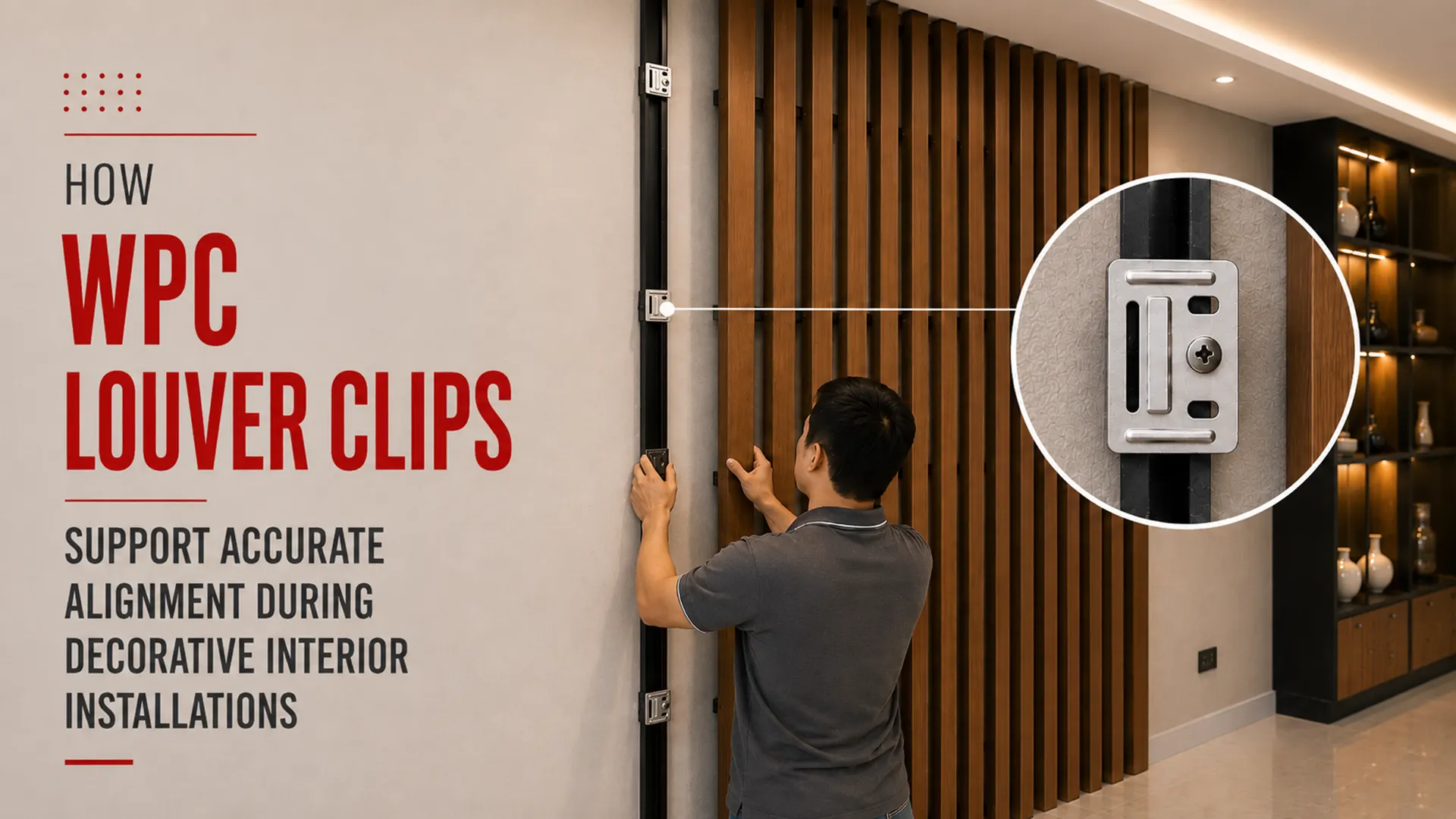
How WPC Louver Clips Support Accurate Alignment During Decorative Interior Installations
Decorative linear installations depend heavily on alignment. When repeated profiles run across a large surface, even a small variation in spacing or positioning can become noticeable. The fixing accessories used behind the finished surface therefore have an important role in maintaining a consistent arrangement. WPC Louvers Clips can support this process by helping installers position and secure suitable louver profiles with greater control.
Buildwell interior decoration range includes WPC louvers along with fluted panels, SS louvers, PVC panels, UV marble sheets and related profiles and accessories. This wider range reflects how modern decorative installations depend on both visible finishes and the components used to assemble them.
Why alignment matters in linear designs
Repeated lines naturally attract attention.
When several louver profiles are installed next to one another, the eye follows their direction and spacing. Any irregularity can interrupt the rhythm and make the completed feature appear less refined.
This is why installation planning needs to begin before the first profile is fixed. Measurements, reference lines and spacing should be established according to the intended design.
Buildwell considers these details important because the quality of a decorative installation depends not only on the visible profile but also on how accurately the individual elements are positioned.
The clip works behind the finished appearance
A fixing accessory may remain almost completely hidden after installation, yet it can influence the final result.
The purpose of a clip is to help establish a controlled connection between the decorative profile and its supporting arrangement. When used appropriately, it can help maintain the intended position while keeping the visible surface free from unnecessary fixing details.
For WPC Louvers Clips, the value is therefore closely connected with installation control rather than visual decoration.
The accessory supports the process while the louver remains the primary visible design element.
Consistent spacing creates visual rhythm
One of the defining characteristics of louver installations is repetition.
The distance between profiles determines how dense or open the finished arrangement appears. Consistent spacing produces a predictable rhythm, while uneven gaps can make the same design feel irregular.
Buildwell encourages installers to establish a clear spacing reference before beginning the installation.
Using WPC Louvers Clips as part of an organised fixing process can support accurate positioning where the selected clip and louver system are compatible.
The final appearance depends on maintaining the same visual logic from the beginning to the end of the installation.
Planning the supporting structure
Decorative profiles still need an appropriate base for installation.
The supporting arrangement should be planned according to the intended layout, dimensions and application. Reference lines can help installers determine where individual profiles need to begin and how they should continue across the surface.
Buildwell recommends preparing the installation area before fixing decorative components rather than trying to correct the arrangement as the work progresses.
This preparation helps WPC Louvers Clips function as part of a planned installation sequence instead of being used to compensate for an inaccurately prepared surface.
Corners and edges require additional attention
A linear feature may look consistent across its main area but become visually weaker around its boundaries.
Corners, edges, openings and adjoining surfaces can interrupt the regular pattern. These areas should therefore be considered before installation begins.
Buildwell encourages contractors to determine how the profiles will meet these points and where the visible lines should terminate.
Careful planning of WPC Louvers Clips placement can help maintain control around selected installation areas where the fixing system is appropriate.
The objective is to make the entire feature look consistent rather than focusing only on its centre.
Alignment becomes more important across larger areas
A small decorative section may hide minor inconsistencies.
Large installations are less forgiving because the repeated lines extend over a greater distance. Any gradual deviation can become more obvious as additional profiles are added.
This is why installers should periodically check alignment instead of assuming that the initial reference point will remain accurate throughout the complete installation.
Buildwell supports this methodical approach because accuracy is easier to maintain than to restore after the entire feature has been completed.
For WPC Louvers Clips, consistent positioning across the supporting arrangement can contribute to a more controlled installation when used according to the intended system.
Lighting can expose small inconsistencies
Decorative linear finishes interact strongly with light.
Directional lighting can emphasise the edges of individual profiles and create shadows between them. This can make variations in spacing or alignment more noticeable than they might appear under softer lighting.
Buildwell recommends considering the lighting plan when deciding where a louver feature should be positioned.
A carefully installed WPC Louvers Clips arrangement can support the consistent placement of the visible profiles, helping the repeated lines maintain their intended rhythm when illuminated.
Lighting should therefore be considered during planning rather than after installation.
Furniture and architectural features influence placement
A louver installation rarely exists independently.
Furniture, lighting fixtures, doors, openings and other interior features may occupy the same visual field. Their positions can influence where the decorative profiles should begin, end or change direction.
Buildwell encourages designers to coordinate the decorative layout with the broader interior plan.
This can prevent situations where a strong linear feature appears to stop awkwardly behind furniture or conflicts with an adjoining architectural element.
Installation accuracy affects the overall finish
The visible quality of a louver installation is closely connected with the accuracy of its hidden fixing process.
If profiles are not positioned correctly at the beginning, later adjustments may become increasingly difficult. Establishing measurements and checking the arrangement throughout the work can help maintain consistency.
Buildwell recommends that installers treat every fixing point as part of the complete visual pattern rather than as an isolated connection.
When WPC Louvers Clips are suitable for the selected system, their use can form part of this controlled installation approach.
Choosing accessories according to the system
A fixing accessory should not be selected independently from the decorative profile.
Compatibility between the clip, louver and supporting arrangement is important because the components need to work together as intended. Project teams should therefore review product specifications and installation guidance before purchasing or installing accessories.
Buildwell interior decoration portfolio includes multiple surface products and associated profiles and accessories.
This makes system based planning particularly relevant when selecting WPC Louvers Clips for a specific decorative installation.
The hidden components influence visible results
Interior detailing often works this way.
The components that attract the least attention during installation can have a significant influence on what the viewer eventually sees. Accurate fixing supports consistent positioning, while consistent positioning preserves the geometry of the finished feature.
Buildwell believes that professional finishing depends on respecting both visible and concealed aspects of an installation.
The clip may remain out of sight, but its role within the fixing process can contribute to the overall precision of the decorative arrangement.
Conclusion
A successful louver installation depends on more than the appearance of the visible profiles. Accurate measurement, consistent spacing, supporting preparation, edge detailing, lighting considerations and suitable fixing accessories all contribute to the final result.
WPC Louvers Clips can support controlled positioning in suitable louver installations where the accessory is compatible with the selected system. Their importance lies in helping installers manage the fixing process while preserving the clean linear appearance that makes louver features visually effective.
Buildwell encourages architects, contractors and interior professionals to approach decorative installations as complete systems. Buildwell interior decoration portfolio includes WPC louvers alongside fluted panels, SS louvers, PVC panels, UV marble sheets and related accessories.
When the visible finish and concealed fixing arrangement are planned together, decorative installations can achieve better consistency and a more refined appearance. Good alignment begins long before the final profile is visible.
Contact Buildwell
Email: sales@buildwell.in
WhatsApp: 7900336699
Toll Free: 1800 102 8031