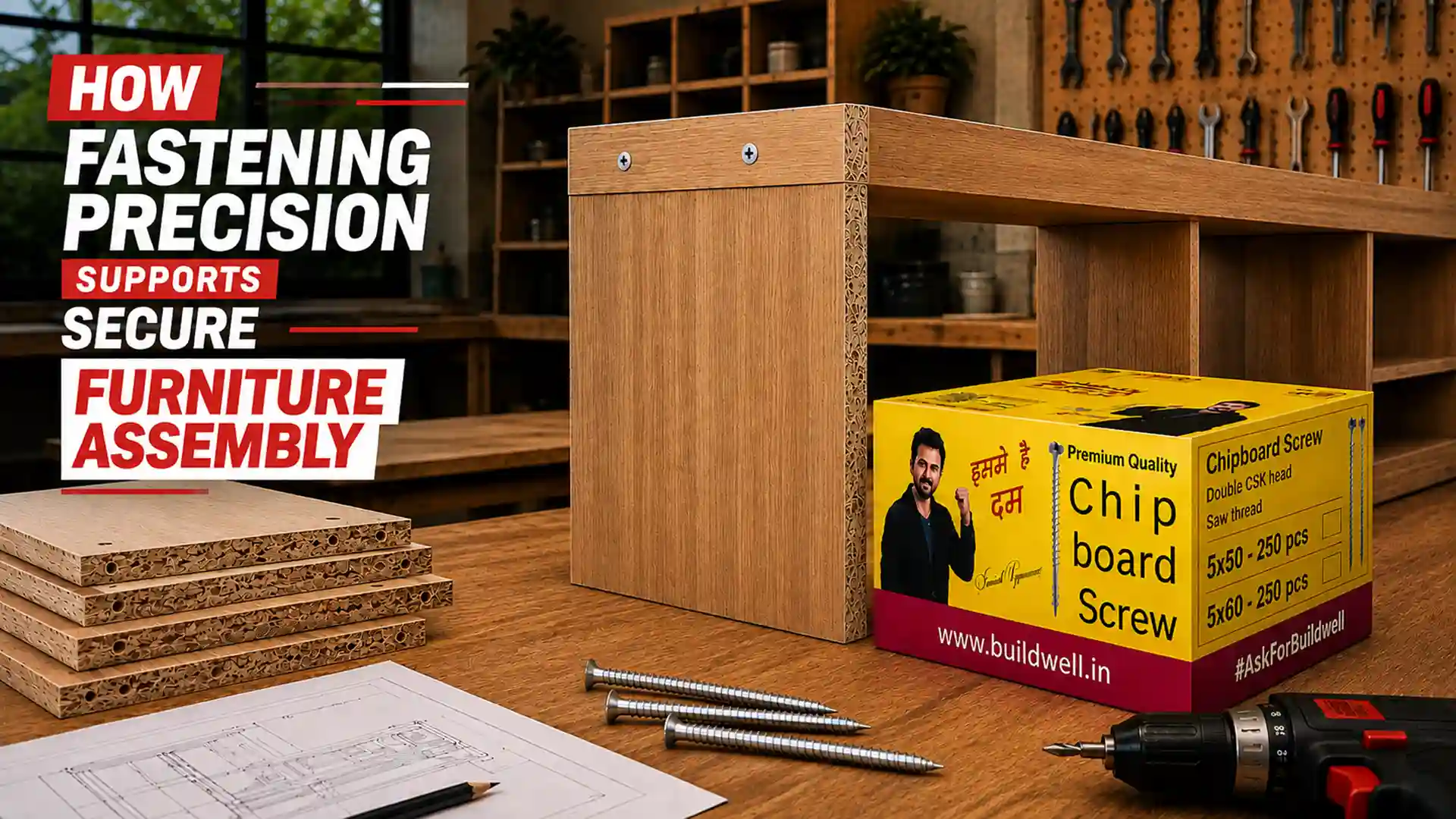
How fastening precision supports secure furniture assembly
Furniture construction depends on details that are rarely visible once the final piece is assembled. Joint alignment, panel positioning, edge integrity and fastening accuracy all influence whether a cabinet, wardrobe, shelf or storage unit feels properly built. A Chipboard Screw is designed for fastening applications involving engineered wood materials, making its selection and use an important consideration when consistent furniture assembly is required. Buildwell recognises that dependable furniture construction is not simply about joining two panels but about creating connections that remain accurate through the assembly process.
From modular furniture to commercial cabinetry, repeated fixing points make precision increasingly important. A small inconsistency at one joint may appear insignificant, but when repeated across an entire unit it can affect the appearance, alignment and usability of the finished product.
The connection begins at the joint
Furniture panels need to meet at specific angles and positions.
Whether two boards form a cabinet corner or a shelf meets a vertical panel, the connection needs to remain accurately positioned while the fastener is driven. If the panels shift during this stage, the final joint may not sit as intended.
Buildwell focuses on fastening products that support controlled furniture assembly. A Chipboard Screw can help establish a direct connection in suitable engineered wood applications when the fastener dimensions and installation method are correctly selected.
The quality of the joint therefore begins before the screw is fully driven.
Thread design matters inside engineered wood
Engineered wood materials behave differently from solid timber.
Their internal structure is manufactured from wood particles or fibres combined under controlled processes. This makes thread engagement an important consideration when selecting a fastener for furniture construction.
A suitable Chipboard Screw is designed around the requirements of these materials, allowing the threads to engage with the board during installation.
Buildwell encourages furniture manufacturers and installers to select fasteners according to the board type, thickness and intended connection rather than relying on one screw specification for every application.
The fastener should complement the material rather than simply penetrate it.
Head seating affects the finished joint
The screw head eventually becomes part of the completed connection, even when it is concealed by a finishing treatment or positioned within a recessed area.
If the head does not seat correctly, it can interfere with adjoining components or create an uneven surface. Excessive driving can also damage the area surrounding the fixing point.
Buildwell recommends controlled installation so the fastener reaches the intended position without unnecessary force.
For a Chipboard Screw, correct head seating can contribute to cleaner assembly and reduce the possibility of visible or functional irregularities around the fixing point.
Precision is therefore measured in millimetres, not just in whether the screw has entered the board.
Panel thickness changes the equation
Furniture construction uses panels with different dimensions depending on the product.
A lightweight cabinet component may require a different fastener length from a thicker structural panel. Selecting an unsuitable length can affect the quality of the connection or create complications on the opposite side of the material.
Buildwell encourages manufacturers to consider panel thickness, joint configuration and the depth available for fastening before selecting the product.
The correct Chipboard Screw should provide appropriate engagement for the intended connection without extending beyond the material unnecessarily.
This is particularly important in finished furniture where every visible surface matters.
Accuracy becomes critical in repeated assembly
One cabinet may contain dozens of individual connections.
A modular kitchen, wardrobe or storage system can involve hundreds of fixing points across multiple components. When the same fastening operation is repeated at this scale, small inconsistencies can accumulate.
Buildwell understands that furniture production benefits from repeatable fastening methods that allow different units to maintain consistent dimensions and alignment.
Using a Chipboard Screw appropriate to the application can support this repeatability when combined with controlled positioning and suitable installation tools.
The real advantage appears across the entire production line rather than at one isolated joint.
The fastener also affects assembly speed
Furniture manufacturing often operates around carefully planned production sequences.
Workers may move from cutting and edge preparation to drilling, assembly and finishing within a defined workflow. A fastening method that fits naturally into this sequence can reduce unnecessary interruptions.
Buildwell considers installation efficiency alongside connection quality because speed has value only when it does not compromise accuracy.
A properly selected Chipboard Screw can support efficient repetitive assembly where its dimensions and application are suitable for the furniture component.
The objective is consistent production rather than simply faster screw driving.
Tool control protects the board
Fastening performance depends partly on the equipment used during assembly.
Incorrect driver settings or excessive pressure can damage the board surface, affect head seating or create inconsistencies between fixing points. Controlled tool operation allows manufacturers to achieve greater repeatability.
Buildwell encourages furniture teams to use compatible tools and maintain consistent installation settings throughout production.
When a Chipboard Screw is installed with appropriate control, the connection can be created more consistently while reducing unnecessary damage around the fixing point.
This becomes especially valuable in factory environments where the same operation is repeated throughout the day.
Precision protects furniture alignment
A furniture unit can look simple from the outside while containing numerous carefully positioned components.
Shelves need to sit level, doors need to meet correctly and cabinet panels need to maintain their intended geometry. Fastening accuracy contributes to keeping these relationships consistent during assembly.
Buildwell sees this as one of the most important practical reasons for paying attention to fastening precision.
A Chipboard Screw is only one part of the process, but its position, depth and engagement can influence how securely the connected panels remain in their intended relationship.
Good assembly is ultimately about maintaining geometry.
Where furniture applications benefit most
Fastening requirements vary across furniture categories.
Cabinet construction, wardrobes, shelving systems, storage units, office furniture and modular interiors can all involve engineered wood panels that require reliable connections. Each application may have different thicknesses, loads and joint configurations.
Buildwell encourages manufacturers to evaluate the actual furniture design before selecting the fastener specification.
For suitable applications, Chipboard Screw products can support secure connections across engineered wood components while fitting into organised assembly processes.
The right fastener should always be chosen according to the connection rather than simply the furniture category.
Small fixing errors can become visible later
Some assembly problems do not appear immediately.
A slightly misaligned panel may only become noticeable once doors, handles, shelves or adjoining components are installed. Correcting such issues after assembly can take more time than preventing them at the fastening stage.
Buildwell recommends treating each fixing point as part of the furniture’s overall geometry rather than as an isolated task.
Accurate use of a Chipboard Screw can contribute to more predictable assembly when the fastener, tool, panel and joint are properly matched.
Prevention is especially valuable in furniture production where repeated correction can affect both productivity and consistency.
The finished product reflects the assembly process
Customers rarely see the fastening operation, but they experience its results.
A cabinet that opens smoothly, a shelf that sits correctly or a wardrobe with consistent panel alignment reflects careful assembly. These qualities are created through many small decisions during production.
Buildwell believes that fastening deserves attention because it contributes to the precision customers ultimately notice.
When Chipboard Screw selection is combined with accurate positioning, suitable tools and controlled installation, furniture manufacturers can create cleaner and more dependable assemblies.
Conclusion
Furniture precision is built into every connection. Panel thickness, thread engagement, head seating, tool control, fixing position and assembly sequence all influence how accurately a finished unit comes together.
A Chipboard Screw can support secure and precise fixing in suitable engineered wood applications when the product is matched correctly to the material and connection. Its contribution extends beyond simply holding panels together. Accurate fastening can support alignment, repeatable assembly and a cleaner finished product.
Buildwell continues to provide Fastening Products for modern construction and interior applications where dependable connections and controlled installation matter. Buildwell encourages furniture manufacturers, contractors and installers to evaluate fasteners as part of the complete assembly process rather than treating them as interchangeable components.
When the fastener specification, furniture material and installation method work together, even small fixing points can contribute to a finished product that feels more precise, stable and professionally assembled.
Contact Buildwell
Email: sales@buildwell.in
WhatsApp: 7900336699
Toll free: 1800 102 8031
Recent Posts