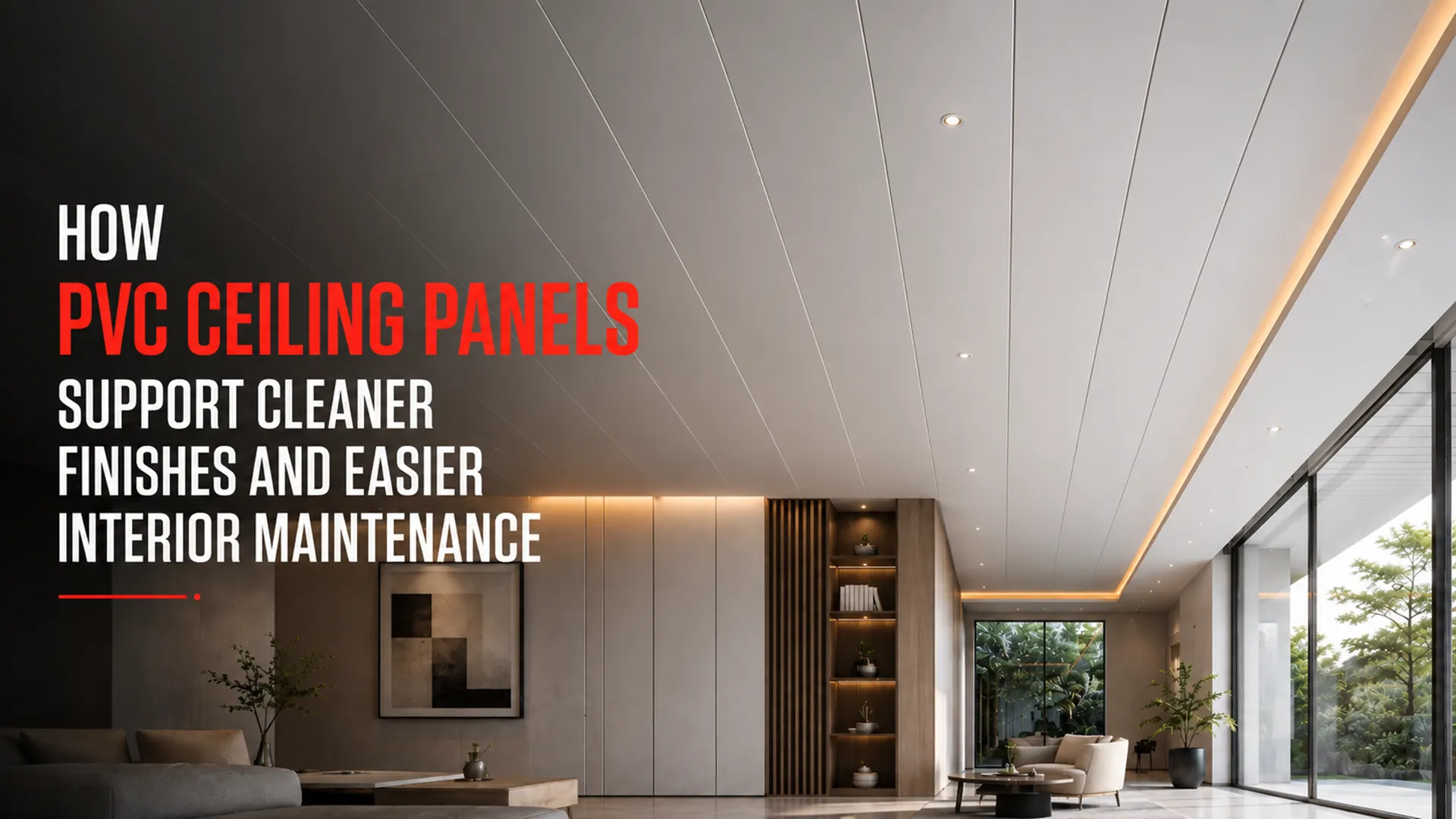
How ceiling finishes support cleaner interiors and easier maintenance
A ceiling plays a quiet but important role in how an interior looks and functions. It influences the visual balance of a room, works alongside lighting and often conceals essential building services. In spaces where regular cleaning or moisture exposure is part of everyday use, the ceiling finish also needs to remain practical after installation. PVC Ceiling Panels can be considered for suitable interiors where a neat appearance needs to work alongside straightforward upkeep.
Buildwell looks at ceiling materials from both design and practical perspectives. The right finish should suit the character of the room while fitting naturally into the way the space will be used and maintained.
The ceiling should suit the room’s purpose
A ceiling inside a bedroom does not face the same demands as one in a restaurant, retail outlet or utility area.
The level of occupancy, cleaning frequency, moisture exposure, lighting arrangement and surrounding finishes can all influence the appropriate choice. Starting with these factors gives designers a clearer basis for selecting a suitable ceiling treatment.
Buildwell encourages project teams to understand the role of each room before finalising its overhead finish. This avoids using one design approach simply for the sake of uniformity.
A restrained surface can create visual order
Modern interiors often rely on simplicity.
When furniture, lighting and decorative features already provide visual interest, an overly elaborate ceiling can make the room feel busy. A clean ceiling treatment can instead create a calm background that allows other architectural elements to stand out.
With PVC Ceiling Panels, designers can explore different profiles and finishes while maintaining a controlled overall appearance.
Buildwell believes that the strongest interiors are not necessarily those with the most decoration. They are the ones where every visible element has a clear reason to be there.
Moisture exposure deserves early attention
The operating environment can change the requirements of an interior finish.
Areas such as kitchens, utility spaces, hospitality interiors and locations subject to frequent cleaning may experience more moisture than dry living or office spaces. These conditions should be considered before the ceiling material is selected.
For PVC Ceiling Panels, the intended application and product recommendations should be reviewed alongside the conditions expected at the site.
Buildwell encourages designers to assess the actual environment instead of making material decisions based only on appearance.
Maintenance is part of the material decision
A ceiling may not require daily attention, but it still forms part of the building’s maintenance routine.
Dust accumulation, occasional marks and routine cleaning can gradually influence the appearance of overhead surfaces. In commercial properties, these activities may occur more frequently because presentation forms part of the visitor experience.
Buildwell believes maintenance expectations should be discussed during the design stage.
Where appropriate, PVC Ceiling Panels can fit into interiors where regular surface care needs to remain practical and manageable.
This shifts the conversation from simply asking how a ceiling looks to asking how it will function during everyday use.
Lighting changes how the surface is perceived
The relationship between a ceiling and lighting can be easy to overlook.
Downlights, spotlights, concealed illumination and daylight can highlight differences in alignment, surface texture and panel arrangement. A finish that appears subtle in one lighting condition may create a very different impression under focused illumination.
Buildwell recommends considering the lighting plan before finalising the ceiling layout.
The appearance of PVC Ceiling Panels should therefore be evaluated as part of the complete room rather than viewed independently as a sample.
When the lighting and ceiling work together, the interior feels more deliberately composed.
Service access should not be an afterthought
Modern overhead areas often contain electrical connections, ventilation components, lighting equipment and other essential services.
These systems may need inspection or maintenance after the interior has been completed. A ceiling design should therefore accommodate the practical requirements of the building without compromising its visual character.
Buildwell encourages contractors and designers to understand service locations before finalising the installation arrangement.
Using PVC Ceiling Panels in a carefully planned layout can help project teams consider both the finished appearance and the practical needs of the space.
Small details influence the finished appearance
The quality of a ceiling is often judged through its edges and transitions.
Corners, fixture openings, connections with adjoining surfaces and changes in direction can become visually noticeable when they are poorly planned. Consistent alignment and thoughtful detailing help the ceiling feel like an integrated part of the interior.
Buildwell considers installation detailing an important part of translating a design concept into a finished space.
The selected Ceiling Material should therefore be supported by careful measurement and accurate execution rather than treated as a standalone product decision.
Different spaces can use different expressions
There is no requirement for every room in a building to have exactly the same visual treatment.
A residential area may benefit from a subtle ceiling while a commercial reception or hospitality setting could use a more distinctive finish. Varying the treatment according to the function of each area can create stronger visual hierarchy throughout the property.
Buildwell supports this approach because it gives designers more freedom to respond to the character of individual spaces.
The result can feel coordinated without becoming repetitive.
What makes a ceiling easier to live with?
The most successful ceiling choices balance several considerations at once.
They should complement the interior, suit the surrounding environment, fit the maintenance routine and accommodate the practical requirements of the building. A finish that performs well visually but creates unnecessary operational challenges may not be the strongest choice.
Buildwell encourages architects, contractors and property teams to consider these factors before installation rather than addressing them after completion.
This broader evaluation helps ensure that PVC Ceiling Panels are used where their characteristics genuinely suit the project.
Conclusion
A well-chosen ceiling finish should remain useful after the initial excitement of project completion has passed. Its visual character, relationship with lighting, suitability for the environment, maintenance requirements and compatibility with building services all influence its long-term practicality.
PVC Ceiling Panels can support cleaner and more organised interiors when they are selected for appropriate applications and incorporated thoughtfully into the overall design. Their effectiveness depends on more than the material itself. Layout, detailing, surrounding conditions and the way the space will be maintained all contribute to the final outcome.
Buildwell continues to support architects, contractors and interior professionals with products designed for contemporary interior requirements. Buildwell approach is to encourage material choices that consider both the appearance of a finished space and the realities of using it every day.
A ceiling should not merely fill the space above. When carefully considered, it can contribute to a cleaner visual environment, a more coherent design and a more practical interior experience.
Contact Buildwell
Email: sales@buildwell.in
WhatsApp: 7900336699
Toll free: 1800 102 8031