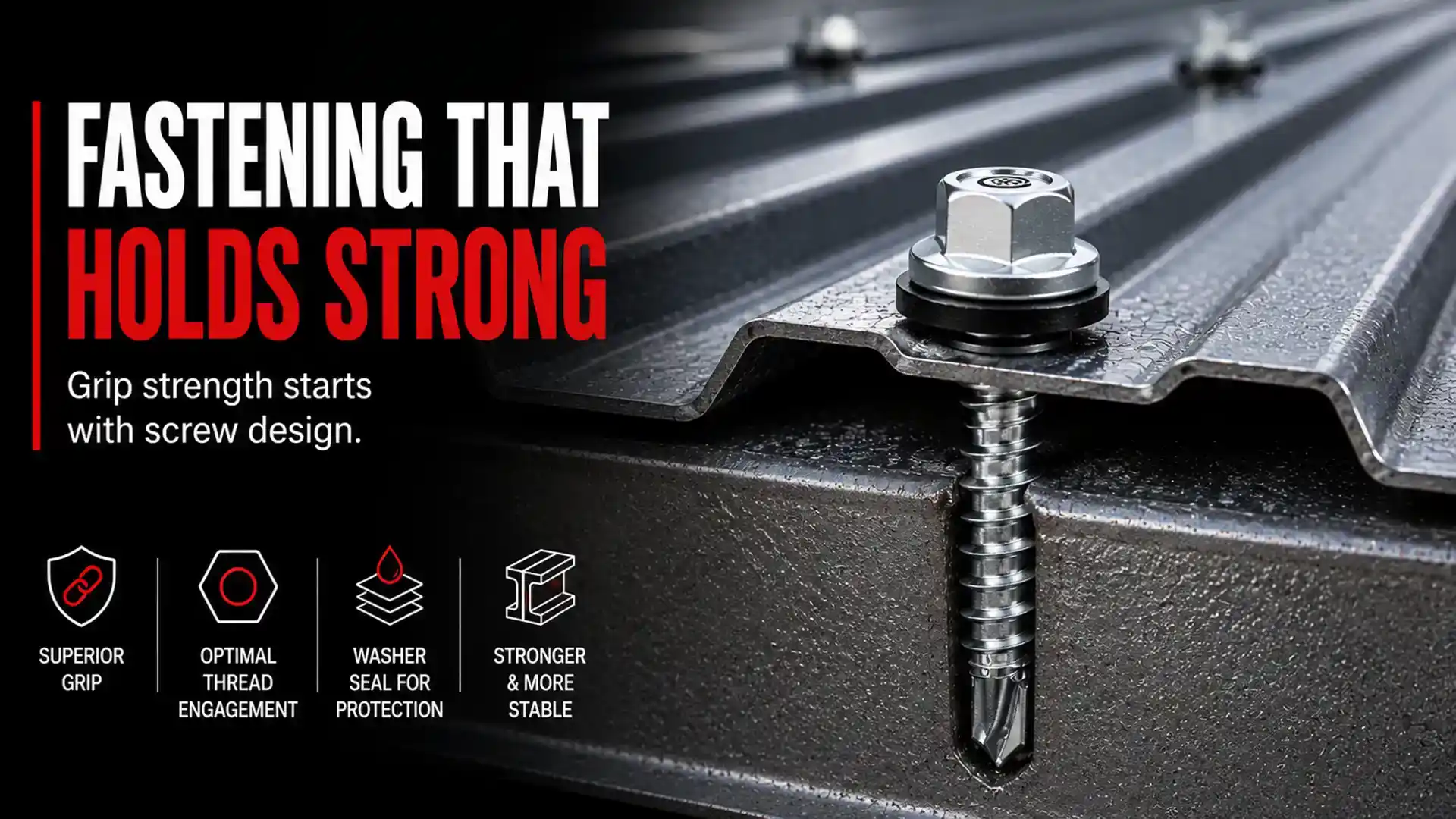
How fastening design impacts grip strength and stability in structural applications
In structural and installation work, fastening systems are often treated as small supporting components. Yet the choice of a Hex Head Screw can have a significant impact on installation strength, load distribution, and long-term reliability. Experienced contractors and project engineers understand that fastening performance directly influences the stability of the entire assembly.
A structure may use strong framing systems and durable surface materials, but overall performance can still become compromised if the fastening system fails to maintain proper grip, torque control, and holding strength. This is why selecting the right screw is not just a hardware decision—it is a critical part of ensuring structural integrity and installation efficiency.
This is why fastening design matters far beyond simple attachment.
Thread shape, head structure, holding pressure, installation stability, and load distribution all influence how securely a connection performs over time. In structural applications where continuous pressure, vibration, environmental exposure, and operational movement exist, even minor fastening inconsistency gradually affects alignment and long-term stability.
At Buildwell, the focus is on supporting reliable fastening performance under practical project conditions. That is why contractors increasingly evaluate a Hex Head Screw not only for installation convenience, but for grip strength, holding stability, and structural reliability across demanding applications.
Because strong structures depend heavily on how securely their fastening systems perform every day after installation.
Grip strength depends on fastening geometry
One of the biggest factors influencing fastening performance is geometry.
The shape and structure of a fastening system directly affect how pressure distributes during installation and long-term usage. If fastening geometry creates uneven stress concentration, the connection gradually weakens under operational load.
A properly designed Hex Head Screw helps improve:
- Surface contact stability
- Torque handling during tightening
- Pressure distribution across the fixing area
- Structural holding consistency over time
This becomes especially important in installations exposed to vibration, repeated load, or environmental movement.
Buildwell focuses on fastening systems designed for balanced structural interaction during practical applications.
Because fastening strength depends heavily on how the design manages force distribution.
Head structure influences tightening stability
The head design of a fastening system affects installation control much more than many people realize.
If the head structure fails to maintain stable tool engagement during tightening, installers often experience:
- Uneven tightening pressure
- Slippage during application
- Inconsistent holding force
- Reduced alignment control
Over time, these installation inconsistencies create weak structural points within the assembly.
A properly designed Hex Head Screw improves tightening precision and allows better torque transfer during installation. This helps contractors maintain more controlled fastening stability across large projects.
Buildwell develops fastening products designed for practical installation efficiency and repeatable structural performance.
Because stable tightening directly affects long-term grip reliability.
Thread design controls long-term holding performance
Thread structure is one of the most critical elements in fastening behaviour.
Grip strength depends heavily on how threads interact with the receiving material during installation and operational usage. Poorly balanced thread geometry may initially appear stable but gradually lose holding consistency under load pressure.
This eventually creates:
- Loosening under vibration
- Reduced structural stability
- Alignment movement
- Increased stress near fastening zones
Reliable thread design helps maintain stronger engagement throughout long-term operational exposure.
A dependable Hex Head Screw supports more stable structural performance by improving grip consistency under continuous pressure.
Buildwell focuses on fastening systems designed for practical holding reliability in demanding installation environments.
Because thread behaviour determines how securely structures remain connected over time.
Load distribution affects structural stability
Fastening systems continuously experience load pressure during operation.
Structural applications expose fasteners to:
- Weight transfer
- Movement stress
- Thermal expansion cycles
- Vibration exposure
- Environmental pressure changes
If load distribution becomes uneven around fastening points, structures gradually develop instability near connection zones.
Reliable fastening systems help spread operational stress more evenly throughout the assembly.
A properly engineered Hex Head Screw improves load balance and reduces concentrated pressure near fixing areas.
Buildwell develops fastening products designed for stable structural coordination under real operational conditions.
Because long-term stability depends heavily on balanced load transfer.
Installation precision improves structural alignment
Fastening design also influences installation accuracy directly.
When fasteners behave inconsistently during application, contractors often spend additional time correcting:
- Structural alignment
- Surface positioning
- Connection stability
- Assembly balance
This slows down workflow and increases installation variability across larger projects.
Reliable fastening systems improve:
- Positioning accuracy
- Alignment consistency
- Structural coordination during assembly
- Reduced correction work later
A stable Hex Head Screw helps contractors maintain smoother installation flow and more balanced structural performance.
Buildwell focuses on fastening systems designed for predictable application behaviour under practical project conditions.
Because accurate installation creates stronger structures over time.
Environmental exposure affects fastening behaviour continuously
Structural fasteners rarely operate under static conditions.
Temperature variation, humidity exposure, airflow movement, and operational vibration continuously influence how fastening systems behave throughout their lifespan.
Weak fastening systems gradually begin showing:
- Reduced grip consistency
- Structural movement near fixing points
- Surface instability around assemblies
- Increased maintenance requirements over time
Reliable fastening design helps maintain better performance despite changing environmental conditions.
A dependable Hex Head Screw supports more stable structural behaviour under practical environmental exposure.
Buildwell develops fastening systems designed for real operational environments instead of ideal laboratory conditions.
Because environmental stress continuously tests fastening reliability after installation.
Vibration resistance matters in long-term applications
Many structural systems experience repeated vibration during daily operation.
Mechanical equipment, airflow systems, operational movement, and structural usage all create vibration patterns that gradually influence fastening stability.
Poor fastening coordination eventually causes:
- Loosening connections
- Reduced grip pressure
- Structural noise
- Misalignment over time
Reliable fastening systems maintain stronger engagement under repeated operational movement.
A properly designed Hex Head Screw improves vibration resistance by supporting more stable holding interaction between connected surfaces.
Buildwell focuses on Fastening Products designed for long-term structural stability under active usage conditions.
Because vibration slowly weakens poorly coordinated fastening systems.
Large projects require repeatable fastening consistency
In large commercial and industrial projects, fastening performance must remain stable across thousands of fixing points.
Even small variation in:
- Grip behaviour
- Thread consistency
- Tightening response
- Structural holding pressure
eventually creates visible inconsistency throughout the project.
Reliable fastening systems help maintain:
- Better structural continuity
- More stable alignment
- Reduced maintenance correction
- Cleaner installation coordination across larger assemblies
A dependable Hex Head Screw supports repeatable fastening performance throughout extended project execution.
Buildwell focuses on practical fastening reliability designed for large-scale structural applications.
Because bigger projects amplify every fastening inconsistency more clearly.
Maintenance efficiency improves with reliable fastening systems
Fastening stability also affects long-term maintenance requirements.
Weak structural connections often require:
- Re-tightening
- Alignment correction
- Component replacement
- Structural adjustment during operational use
This increases maintenance effort and operational interruption over time.
Reliable fastening systems improve:
- Structural durability
- Connection stability
- Long-term assembly consistency
- Reduced maintenance frequency
A properly engineered Hex Head Screw supports more dependable long-term structural behaviour under continuous operational conditions.
Buildwell develops fastening systems designed for practical durability instead of temporary installation performance alone.
Because reliable fastening reduces future structural maintenance problems.
Why professionals prioritize fastening design carefully
Experienced contractors and engineers know that fastening systems influence much more than simple attachment.
They carefully evaluate:
- Grip strength
- Thread reliability
- Torque handling stability
- Environmental adaptability
- Vibration resistance
- Long-term structural consistency
This system-level approach improves:
- Structural durability
- Installation precision
- Operational stability
- Long-term project reliability
Buildwell aligns with these professional expectations by supporting fastening systems designed for practical construction and operational performance.
Because professional structural quality depends heavily on fastening reliability beneath the surface.
Conclusion: Fastening design shapes long-term structural stability
Structural applications depend heavily on reliable fastening coordination throughout their operational lifespan.
Grip strength, thread behaviour, tightening stability, load distribution, vibration resistance, and environmental adaptability all influence how securely assemblies remain connected over time.
When fastening systems lack stability, structures gradually develop movement, alignment inconsistency, and maintenance-related issues. But when fastening design remains balanced and reliable, structural performance stays cleaner, stronger, and more stable across long-term usage conditions.
Choosing a dependable Hex Head Screw helps improve grip consistency, installation precision, and structural reliability across different project environments.
Buildwell continues supporting modern construction and structural applications with fastening products designed for practical operational conditions, stable grip performance, and long-term reliability. With a focus on structural coordination and real-world durability, Buildwell helps create assemblies that remain secure and balanced long after installation is complete.
Because strong structures always depend on strong fastening foundations.
Contact Buildwell
📧 Email: sales@buildwell.in
💬 WhatsApp: 7900336699
📞 Toll-free: 1800 102 8031
Recent Posts
How manufacturing precision shapes drywall screw performance on site

How PVC wall moulding adds cleaner edges and refined interior detailing