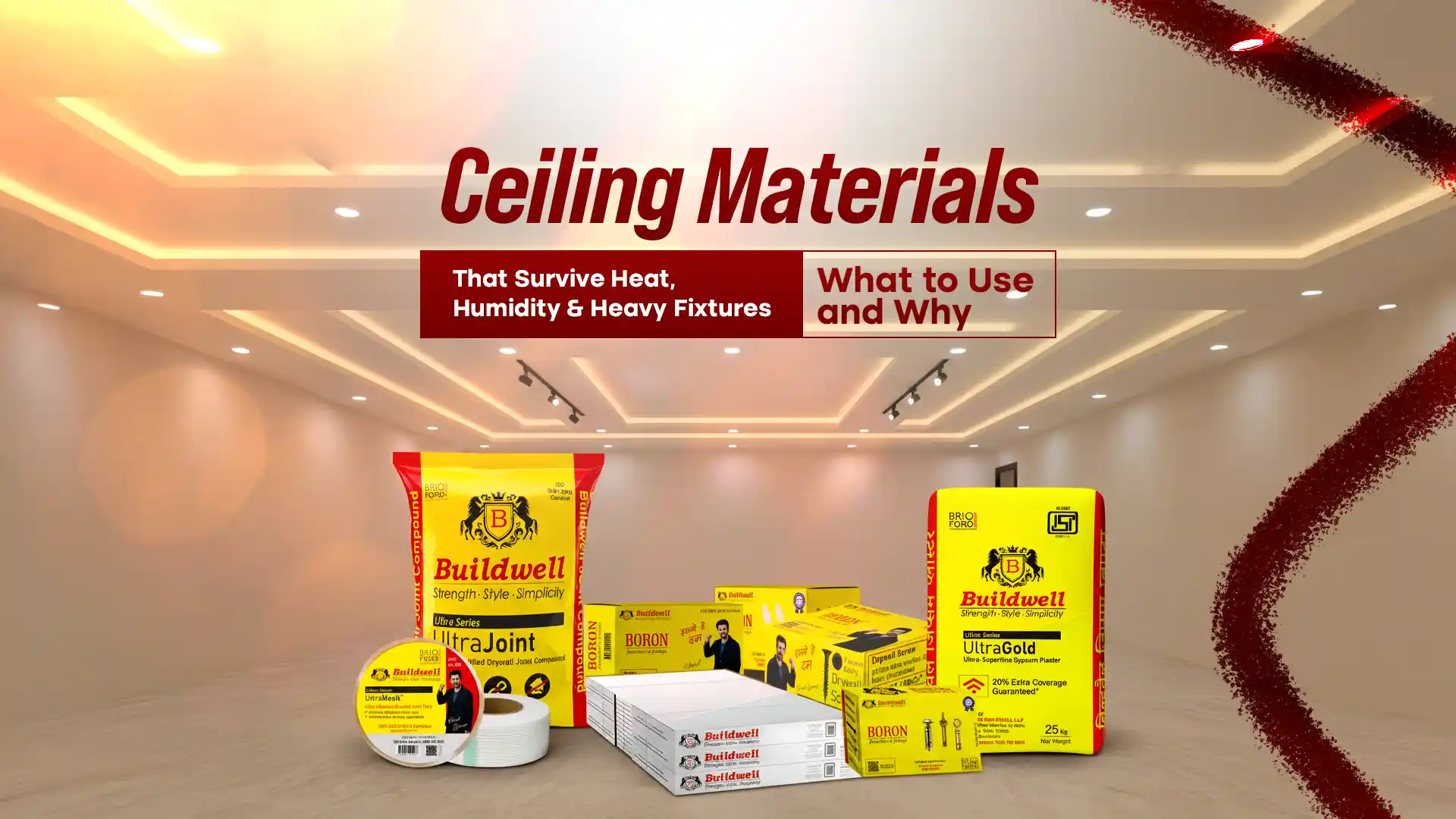
Ceiling Materials That Survive Heat, Humidity, and Heavy Fixtures — What to Use and Why
When a ceiling looks flawless, no one notices it.
But when it cracks, sags, or shows damp patches — it’s the only thing they talk about.
In India’s extreme climates, where peak summer temperatures touch 45°C and monsoon humidity hits saturation, materials are tested like nowhere else.
Add to that the rising demand for embedded lights, HVAC, and decorative fixtures — and you’ve got a structural challenge above your head, quite literally.
The real question becomes: are your Ceiling Materials ready for it?
Not All Ceilings Are Built the Same — And That’s the Problem
On most Indian sites, ceiling decisions are made late. Materials are sourced based on price, not performance. But that quick-fix approach leads to long-term regret.
From residential homes in coastal Kerala to corporate offices in dry Rajasthan, builders face the same issue: generic Ceiling Materials fail when exposed to moisture, heat, dust, or mechanical load.
Cracks, misalignment, visible joints, discoloration, and nail pops — the symptoms vary, but the diagnosis is the same: the wrong materials were used.
What Good Materials Actually Need to Handle
Before you think aesthetics, start with function.
Ceiling Materials in India must be able to:
- Resist warping in high temperatures
- Prevent moisture absorption in humid zones
- Carry heavy loads from fans, lights, or false framing
- Stay stable across temperature shifts
- Provide fire resistance in commercial settings
- Avoid termite or fungal damage
The only way to meet all these demands?
Work with a system — not just isolated boards or frames — that’s engineered to handle them together.
This is exactly what Buildwell delivers.
Why More Contractors Now Choose Buildwell for Ceiling Systems
Buildwell doesn’t just supply ceiling boards.
It provides a complete ceiling ecosystem designed to perform together — from boards and tiles to fasteners, T-grids, bonding agents, and jointing compounds.
Every component is tested for Indian jobsite conditions.
That’s why Buildwell is trusted by professionals working in:
- High-humidity apartments in Goa
- Large-scale projects in North Indian heat zones
- Commercial complexes with heavy light and AC loads
- Hospitals and schools that demand fire-safe ceilings
Buildwell understands that reliable Ceiling Materials mean fewer site issues — and that’s where cost savings really happen.
What Happens When You Mix Materials from Different Brands?
It’s one of the most common reasons for ceiling failure:
Boards from one brand. Frames from another. Screws and tapes picked up locally.
At first glance, it saves money. But then problems start:
- Tiles sag because grids don’t hold weight properly
- Board joints crack because the compound wasn’t compatible
- Screws rust because they weren’t designed for humid ceilings
Professionals now prefer Buildwell Ceiling Materials because everything in the system is made to work together. No mismatch. No guesswork.
Moisture Is the Silent Killer — And Not All Boards Can Handle It
In coastal states, poorly sealed boards and frames absorb ambient moisture — slowly weakening the entire ceiling system.
Signs include:
- Softening of edges
- Hairline cracks near cutouts
- Mold patches behind tiles
- Sagging or bowing in the center
That’s why Buildwell ceiling boards are moisture-resistant and treated for long-term structural integrity.
Plus, Buildwell bonding agents and tapes are designed to hold under variable humidity — ensuring that finishes don’t peel or bubble post-installation.
Heavy Fixtures? Don’t Rely on Just the Surface
Indian interiors today are loaded — literally.
From ceiling-mounted chandeliers and track lighting to ducting and projectors, the ceiling bears more weight than ever before.
And if your Ceiling Materials can’t handle it, failure is guaranteed.
Buildwell ceiling systems are load-rated and tested to carry standard fixture weights without warping or structural shift.
Their frames are reinforced, fasteners precisely engineered, and tile systems reliable for long-term durability.
Fire-Rated Materials Are Not Optional Anymore
In commercial or high-rise residential projects, fire resistance is not a luxury — it’s code compliance.
Cheap materials offer no burn resistance. They act as fuel instead of barriers.
Buildwell Boards and ceiling components are available in fire-rated variants, backed with certification and tested to Indian and international safety standards.
From hospitals to data centers, Buildwell Ceiling Materials are helping projects meet safety benchmarks — while maintaining aesthetics and performance.
Why Architects, PMC Teams, and Contractors Prefer Buildwell
Buildwell isn’t just a vendor — it’s a project partner.
Its reputation is built on:
✅ System-level compatibility
✅ Consistent board quality across batches
✅ Fast dispatch and site availability
✅ On-site training and technical support
✅ Data sheets, test reports, and documentation ready
This makes it easier for large teams, site engineers, and consultants to trust Buildwell — especially when the ceiling needs to look perfect and last for years.
Final Word: Don’t Gamble with Your Ceiling
The ceiling might be the last thing installed — but it’s the first thing people see when they enter a room.
And in Indian conditions, only tested, trusted materials can survive long-term without issues.
If you want to avoid cracks, callbacks, damp spots, or design failures — don’t buy components in isolation.
Choose Buildwell Ceiling Materials — the complete system that stands up to Indian heat, moisture, and load.
Because the best ceiling isn’t the one that just looks good — it’s the one you never have to fix.
Want Buildwell Materials at Your Next Project? Connect Today:
📧 Email: sales@buildwell.in
📲 WhatsApp: 7900336699
📞 Toll-Free: 1800 102 8031
Recent Posts
Where construction adhesive glue fits into modern interior installation work